
 Menu
987-65-4329
987-65-4329

 555-666-0606
Xiumei Pang1, Shixin Huang2*, Xue Wang1, Yue Liu1, Dan Zhu1, Qiangqiang Li1, Gang Chen1*
1Key laboratory of agro-product quality and safety, institute of quality standards and testing technology Key laboratory of agro-product quality and safety, institute of quality standards and testing technology for agro-products, chinese academy of agricultural sciences, Beijing, 100081, China
2Shanghai animal disease control center, Shanghai, 201103, China
Received date: 18/06/2016; Accepted date: 28/07/2016; Published date: 01/08/2016
Sedecamycin, Feed, HPLC-UV, LC-MS/ MS.
Swine dysentery, one of the most economically damaging diseases in pig farm [1], is a severe infectious enteric disease which is characterized by diarrhea and marked inflammation in pigs. And Treponema hyodysenteriae is one of the bacterial species that can cause swine dysentery [2,3]. Therapeutic agents such as sedecamycin, carbadox, lincomycin, tiamulin etc., were widely used to control the development of disease, due to their quick and successful curative effect [4,5]. It is reported that in a therapeutic test with mice, bactericidal activity of sedecamycin was two times higher than tiamulin and lincomycin, and similar to carbadox [6]. Another study also shown that sedecamycin can shorten the treatment period (5 days for slight infection, 10 days for severe infection) compared to the 12-day treatment with metronidazole or tylosin, therefore, sedecamycin is more suitable for eradication programmes [7].
Sedecamycin (Lankacidin, Figure 1) was produced by Streptomyces rochei var. volubilis and was classified as a neutral seventeen-membered macrolide antibiotic [8]. Sedecamycin shows its strong antimicrobial activity against Gram-positive bacteria by inhibiting the bacteria protein synthesis in nucleus [9]. Moreover, sedecamycin has an excellent bacteriacidal and inhibiting activity against Treponema hyodysenteriae, thus can control the development of swine dysentery effectively [4].
Due to its strong effectiveness, sedecamycin has been widely used in many pig-raising countries. It is not only used as veterinary therapeutic medicine, but also abused by some farmers as feed additive for precaution and growth promoting purpose [10]. However, like any other antibiotics, overuse of sedecamycin may have side-effects, and will also affect the normal bacteria flora in vivo and cause the emergence of antibiotic resistant bacteria. Nowadays, antibiotic resistance has become an increasing problem which cannot be solved completely and timely [11,12]. Japan has set maximum residues levels (MRLs) for sedecamycin as 0.05 mg/ kg in tissues of swine. Sedecamycin abuse in animal feed can cause residues in animal products if the withdraw period was not strictly followed. This highlights the importance of inspection of sedecamycin in animal feed. Therefore, establishing a reliable method for sedecamycin detection in feed is highly required for fulfilling the feed surveillance program.
The analysis of sedecamycin residue in animal tissues has been established, which include a HPLC method for swine plasma and tissues matrix [13]. Besides, the liquid chromatography coupled with mass spectrometry (LC-MS/MS) method for sedecamycin analysis in swine and chicken tissues (muscle and liver) was also established [14]. However, a method for determining sedecamycin content in animal feed has not been established to our knowledge. Here we described a HPLC and a LC-MS/MS method for sedecamycin content analysis in animal feed. Here we described a HPLC and a LC-MS/MS method for sedecamycin content analysis in animal feed. The purpose of this study is to establish a simple and reliable method for determination of sedecamycin, in order to fulfill the requirement for the feed quality inspection.
Chemicals and sampling
Acetonitrile (HPLC grade, Fisher Scientific, Pittsburgh, PA, USA), formic acid (purity ≥ 88%, Kermel Chemical Reagent Inc. product, Tianjin, China) and ultrapure water from a Millipore Milli-Q water purification system (Millipore, Bedford, MA, USA) were used for mobile phases. Sedecamycin of minimal 98% purity was purchased from WAKO (Osaka, Japan). Porcine complete feed, concentrated feed, pre-mixed feed were all purchased from local company Wanlihe (Beijing Wanlihe Technology Development Co., Ltd., Beijing, China).
Preparation of stock and working standard solution. The stock standard solution (5 mg/ml) was prepared by dissolving 50.0 mg of sedecamycin in 10.0 ml acetonitrile. The stock solution was then further diluted with acetonitrile to obtain the working solution with different concentrations: 10, 50 and 1000 μg/ml. The spiked feed samples were prepared by thoroughly mix of sedecamycin working solution into feed matrix. Stock solutions were stored in darkness at −80°C and were stable at least for 6 months. Working standard solutions were stable at least for 2 months when stored in darkness at 4°C.
Sample extraction
An amount of 5.0 g thoroughly grinded feed was weighed into a 50 ml capped polypropylene copolymer centrifuge tube, and 10 ml of acetonitrile were added for 15 min ultrasonic extraction. Then the samples were centrifuged at 12000 rpm for 15 min at 4°C. The supernatants were transferred to another tube for further cleanup.
Sedecamycin is an alkaline compound that is well soluble in acid aqueous solution and polar organic solvents. We had also used some other organic solvents in the course of the experiment. Such as methanol, acetonitrile, hexane, and ethyl acetate were used for extraction solvent just as the above procedure.
Sample cleanup
The Bond Elut-SI (500 mg, 3 cc, Agilent, CA) cartridges were used for sample cleanup. The cartridges were conditioned with 3 ml of acetonitrile, and then 2 mL of extraction solvent was loaded. The loading speed was controlled to 1.0 ml/min by a valve. The analyte fraction was eluted with 3 ml of acetonitrile and collected. The eluted fraction was evaporated to dryness with nitrogen and reconstituted with 1 ml of acetonitrile by vortex. Elute was filtered through a 0.2 μm PVDF Mini-uniprepTM membrane (Jinteng, Tianjin, China), and then transferred to the autosampler vial for analysis.
Four types of SPE cartridges were compared for sample cleanup, i.e., Oasis HLB (60 mg, 3 cc, Waters), Bond Elut C18 (500 mg, 3 cc, Aglient), Bond Elut SI (500 mg, 3 cc, Aglient) and Oasis MCX (60 mg, 3 cc, Waters). Activation process of SPE cartridges were according to protocol of the products.
Instrumentation
HPLC Condition. The HPLC used was Waters Alliance equipped with a Waters 2695 quaternary pump, auto injector, and 2998 PDA detector (Waters, USA), controlled by Empower 2 networking software (Waters, USA). The analytical column was Eclipse XDB-C18 (250 mm × 4.6 mm × 5 μm, Agilent, CA). The mobile phase consisted of A (100% acetonitrile) and B (ultrapure water) with the following gradient program: 0 - 12 min, 40% A; 12 - 13 min, 40% to 95% A; 13 - 17 min, 95% A; 17 - 17.5 min, 95% to 40% A; 17.5 - 23.5 min, 40% A. The flow rate was set at 1.0 mL/min. A sample volume of 20 μl was injected into the column, separated and eluted using the gradient program. The temperature of column was maintained at 30°C in a column oven. The auto sampler was equipped with a black door avoiding samples to be exposed to light. Photodiode Array Detector (PDA) was used for scanning sedecamycin optimal UV absorption, and the highest absorption appeared at wavelength 225 nm. But due to the strong matrix interference when using HPLC analysis at wavelength 225 nm, the wavelength at 254 nm was selected for sedecamycin signal detection alternatively, and the analyte interference can be removed.
LC-MS/MS Condition. The API 5000 triple quadrupole mass spectrometer (Applied Biosystem, ON, Canada) with an ESI turbo TVM was applied to detection. Analyte was ionized in positive mode and monitored by multiple reactions monitoring (MRM). The spectrometry parameters were as follows: the source temperature (TEM), 550̢̮̉; the ion spray voltage (IS), 5500 V; the curtain gas pressure (CUR), 25 psi; the collision gas (CAD), 5 psi; declustering potential (DP), 161 V; the atomization air pressure (GS1), 60 psi; the auxiliary gas pressure (GS2), 45 psi; the dwell time, 150 ms. Both the Q1 and Q3 analyzer was set on unit resolution. Two pairs of transitions of sedecamycin were selected by the ions with highest intensities that were obtained in the mass spectra. The ion with higher intensity was chosen as quantification while both the ions were utilized for confirmation.
The chomatographic analyses for LC-MS/MS was conducted on Agilent (Palo Alto, Calif., USA) 1200 SL Series equipped with a binary pump, vacuum degasser, autosampler, and column oven. Sedecamycin was separated on an X-Terra C18 column (150 × 2.1 mm, 3.5 μm, Waters, Ireland) at 40°C with 5 μL injection volume and 300 μL/min flow rate. The mobile phase was 0.1% formic acid in water (A) and 100% acetonitrile (B). A linear gradient program was used as follows: 0-1.5 min, 40% B; 1.5-2.5, 40 to 90% B; 2.5 to 5.0; 90%B; 5-5.5, 90% B; 5.5-10, 40% B.
The developed methods were validated for sensitivity, linearity, recovery and precision. Sensitivity of this method was proven by establishing the limit of detection (LOD) and quantitation (LOQ) for sedecamycin with signal-to-noise-ratios (S/N) of 3:1 and 10:1, respectively. The recoveries were evaluated by comparing peak areas of spiked samples and standard solution with the same concentration of sedecamycin. The precision of the method was determined through intra- and inter-day precision and relative standard deviation (RSD). Calibration curves were prepared by series dilution of standard working solutions to six concentration levels, and the linear ranges for HPLC and LC-MS/MS were from 1 μg/ml to 50 μg/ml, and from 0.05 μg/ml to 50 μg/ ml, respectively. Linear regression analysis was performed by plotting peak area versus target analyte’s concentrations using a least-square linear regression model.
The previous HPLC method for sedecamycin analysis in plasma used a normal phase system, which is not commonly used in food and feed matrix analysis. Moreover, normal phase system consumes larger amount of organic solvents than reverse phase system [12]. Here we developed a reverse phase HPLC method for sedecamycin analysis in feed, which is more suitable and more environment friendly. Besides, the LC-MS/MS system was recognized as high selectivity and sensitivity, a LC-MS/MS method was also established as confirmation method. The detailed method optimization was described as following.
Sample extraction and cleanup optimization
Sedecamycin is a hydrophobic compound deduced from its chemical structure (Figure 1).
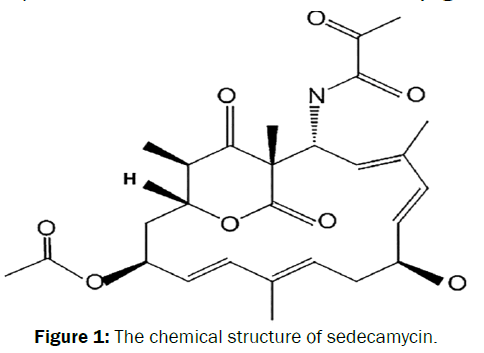
Figure 1: The chemical structure of sedecamycin.
So, in order to select the optimal extraction solvent, methanol, acetonitrile, hexane, and ethyl acetate were used for sample extraction. Results showed that acetonitrile and ethyl acetate gave highest extraction efficiency (Figure 2), but strong matrix interfering peaks were observed in HPLC analysis when extracted by ethyl acetate. Acetonitrile gave cleaner sample extraction, and therefore was selected as extraction solvent for both HPLC and LC-MS/MS analysis.
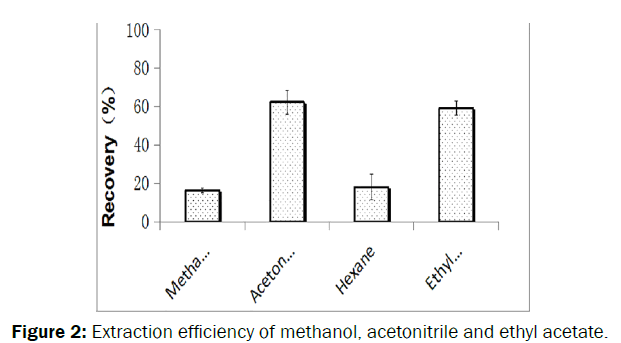
Figure 2: Extraction efficiency of methanol, acetonitrile and ethyl acetate.
By studying the effect of the four types of SPE cartridges, we determined the optimum purification method. Y.B. Ho had a good recory with Oasis [15] (Figure 3) shows that the HLB cartridge has poor keeping capacity to sedecamycin, and recovery was only 25.86 ± 2.44% (Mean ± SD, n = 3). As well, the recoveries of MCX and C18 cartridges were only 32.71 ± 2.41%, and 32.87 ± 2.66%, respectively. On the contrary, SI cartridge gave a very good cleanup efficiency and the lowest matrix interference with the recovery of 89.40 ± 3.21%. Liquid-liquid extraction (LLE) with hexane shows highest cleanup efficiency with the recovery of 92.72 ± 2.90%. Wallace JS had studied of sulfonamide antibiotics were extracted from liquid manure by liquid-liquid extraction (LLE) with methanol following acidification with acetic acid [16]. But the LLE was time consuming and environment unfriendly, therefore SI cartridge was used finally.
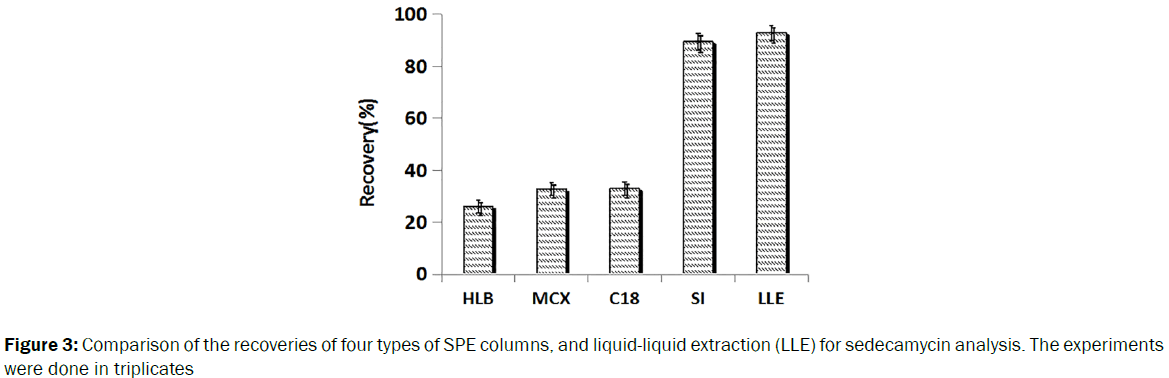
Figure 3: Comparison of the recoveries of four types of SPE columns, and liquid-liquid extraction (LLE) for sedecamycin analysis. The experiments were done in triplicates
HPLC method validation
For the current developed HPLC method, there is no interfering peak observed for the sedecamycin analysis in feed matrix. The retention time obtained for sedecamycin was 12.3 min (Figure 4).
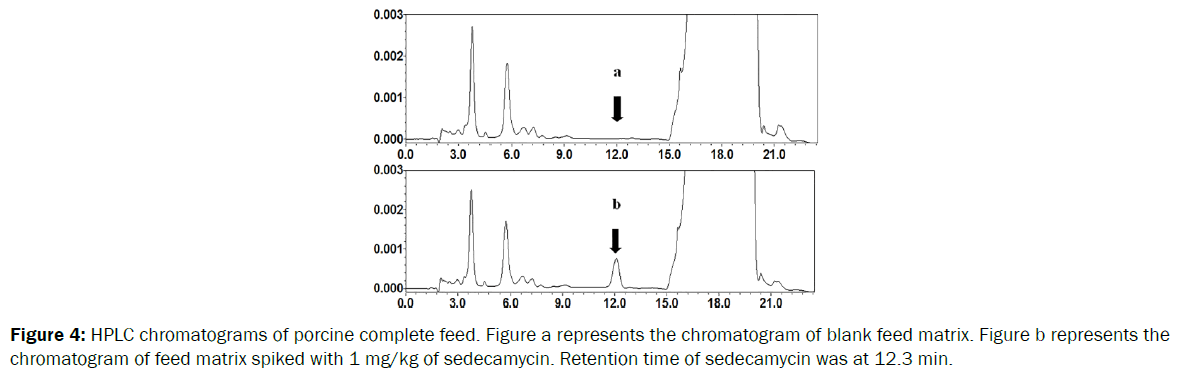
Figure 4: HPLC chromatograms of porcine complete feed. Figure a represents the chromatogram of blank feed matrix. Figure b represents the chromatogram of feed matrix spiked with 1 mg/kg of sedecamycin. Retention time of sedecamycin was at 12.3 min.
The LOD and LOQ were obtained from porcine complete feed, which have the most complicated matrix interference among all types of feeds in this study. As a result, the LOD and LOQ of sedecamycin were 0.3 and 1.0 mg/kg, respectively, which render sufficient sensitivity of this method. It should be noted that the addition of sedecamycin in feed was usually at mg/kg levels [6]. The Chinese feed regulation allows the addition of sedecamycin in feed premix up to 75 mg/kg. It is definitely that the sensitivity of our method can satisfy the routine feed inspection analysis.
Recoveries of three kinds of feed were evaluated at concentration of LOQ in triplicate. Analysis was carried out by spiking the feed samples with sedecamycin standard solution at concentrations of 1 mg/kg. The obtained average recoveries for sedecamycin in porcine complete feed, concentrated feed, and pre-mixed feed were 65.0 ± 6.5%, 78.6 ± 7.0%, and 83.3 ± 4.8% (mean ± SD, n = 3), respectively. The intra-day and inter-day precision were also calculated and the RSDs of recovery are all below 8.72% (Table 1). Therefore, the developed method presents good precision and accuracy.
| Method Matrix | HPLC Method | ||||
|---|---|---|---|---|---|
| LOD w/(mg̢̻̉kg-1) | LOQ w/(mg̢̻̉kg-1) | Added w/(mg̢̻̉kg-1) | Recovery R/% | RSD sr/% | |
| Completefeed | 0.3 | 1 | 1 | 65.0 ± 6.5% | 6.94% |
| concentratedfeed | 0.3 | 1 | 1 | 78.6 ± 7.0% | 8.72% |
| pre-mixedfeed | 0.3 | 1 | 1 | 83.3 ± 4.8% | 6.45% |
Table 1: LODs and LOQs of feed and their recoveries and RSDs in HPLC (n = 3)
During a direct infusion experiment with standard solution of sedecamycin, precursor ion of sedecamycin (m/z + = 502.3) was observed at scanning on Q1 analyzer, and two product ions (124.4 and 107.3) were observed at scanning on Q2 analyzer (Figure 5).
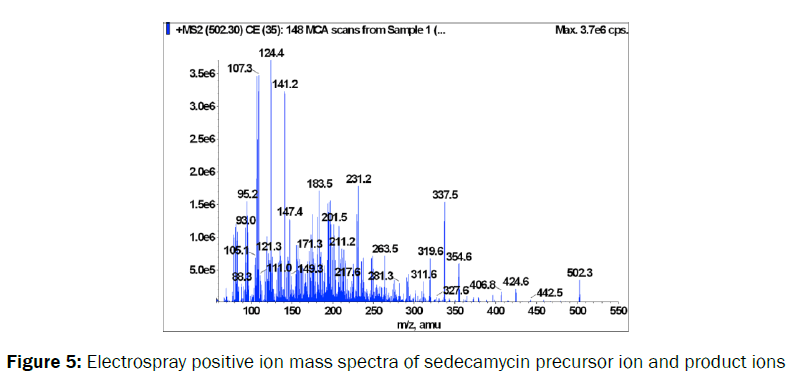
Figure 5: Electrospray positive ion mass spectra of sedecamycin precursor ion and productions.
The ion source temperature, nebulizer gas and ion spray voltage etc. were also investigated to optimize the specificity and sensitivity of ions detection.
For method validation on real samples analysis, the matrix interference was evaluated by comparing the pure standard solution with corresponding standard that were diluted by blank extracts. As a result, no serious matrix effect (≤ 10%) was observed in any feeds of this study. The external standard curve is linear with a good correlation coefficient (r2) > 0.99. The LOD and LOQ of the analyte were 0.015 mg/kg and 0.05 mg/kg, respectively, which give enough sensitivity for real samples analysis.
Recoveries were evaluated by spiking the feed samples with sedecamycin standard solution at three concentration levels at low, medium, and high were 1 mg/kg, 5 mg/kg and 50 mg/kg, respectively. The average recovery for sedecamycin in porcine complete feed, concentrated feed, and pre-mixed feed were 92.62 ± 4.51%, 89.58 ± 7.06%, and 84.43 ± 6.79%, respectively (mean ± SD, n = 3). The intra-day and inter-day precision was also calculated and the RSDs of recovery were all below 10% (Table 2).
| Method Matrix | LC-MS/MS Method | ||||
|---|---|---|---|---|---|
| LOD w/(mg̢̻̉kg-1) | LOQ w/(mg̢̻̉kg-1) | Added w/(mg̢̻̉kg-1) | Recovery R/% | RSD sr/% | |
| Completefeed | 0.015 | 0.05 | 1 | 92.62 ± 4.51% | 5.20% |
| concentratedfeed | 0.015 | 0.05 | 5 | 89.58 ± 7.06% | 9.46% |
| pre-mixedfeed | 0.015 | 0.05 | 50 | 84.43 ± 6.79% | 6.45% |
Table 2: LODs and LOQs of feed and their recoveries and RSDs in LC-MS/MS (n = 3).
In this paper, two analytical methods were established for determination of sedecamycin in feed. The method used acetonitrile for sample extraction, SI SPE cartridge for cleanup. These two methods were the first time for sedecamycin analysis in feed matrix, using reverse phase of HPLC and tandem mass spectra. The validation of these two methods showed that they can be practically used for routine inspection in feed industry.
This work was supported by Chinese Agricultural Standard project from Ministry of Agriculture in China (No. 2013-91-343).