
Research & Reviews: Journal of Agriculture and Allied Sciences
 Menu
MenuISSN: E 2347-226X, P 2319-9857
ISSN: E 2347-226X, P 2319-9857
Mekuanint Tadilo1*, Netsanet Beyero1, Melkamu Bezabih2
1Department of Animal Sciences, Bahir Dar University, Bahir Dar, Ethiopia
2Department of Animal Production and Technology, Wolkite University, Wolkite, Ethiopia
Received: 04-Jul-2024, Manuscript No. JAAS-25-140773; Editor assigned: 09-Jul-2024, Pre QC No. JAAS-25-140773 (PQ); Reviewed: 23-Jul-2024, QC No. JAAS-25-140773; Revised: 13-Jan-2025, Manuscript No. JAAS-25-140773 (R);Published: 20-Jan-2025, DOI: 10.4172/2347-226X.14.1.001
Citation: Tadilo M, et al. Morphological Parameters and Dry Matter Yield of Brachiaria decumbens ILRI-10871 variety Influenced by Fertilizer Application under Rain Fed Conditions. J Agri Allied Sci. 2025;14:001.
Copyright: © 2025 Tadilo M, et al. This is an open-access article distributed under the terms of the Creative Commons Attribution License, which permits unrestricted use, distribution and reproduction in any medium, provided the original author and source are credited.
Visit for more related articles at Research & Reviews: Journal of Agriculture and Allied Sciences
The cause of this test become to assess the morphological parameters and dry count number yield of Brachiaria decumbens ILRI-10871 grown for two years under four fertilizer costs (0, 100, 300 kg N and manure). The field test became done at Robit Bata Kebele in the Bahir Dar Zuria district of Amhara region, Ethiopia. Every 9 m2 plot inside the treatments changed into organized in a 4 x 2 factorial configuration in a randomized complete block layout with 3 replications. Morphological facts were accrued from 10 randomly decided on flowers grown within the center rows of each plot. All recorded datasets have been subjected to a trendy linear version technique of SAS (9.0) at an importance degree of alpha <0.05. The findings established that the morphological characteristics and dry remember yield had been strongly impacted with the aid of the interplay of fertilizer utility and year. The tallest plant (61.93 and 102.33 cm), the very best quantity of tillers in step with plant (30.67 and 120.56) and the best dry count yield (12.5 and 21.88 t/ha) when measured at manure fertilizer in the first and second 12 months production, respectively. Moreover, the very best internet gain turned into obtained from manure fertilizer (22000.44 and 35456.61 birr) within the first and 2nd years, respectively. Consequently, within the research areas and similar agro-ecologies, the Brachiaria decumbens ILRI-10871 with manure fertilizer would have an extra advantageous production performance to satisfy forage quantity and economic feasibility.
Brachiaria decumbens; ILRI-10871 variety; Fertilizer application; Forage yield
Cattle is a primary supply of animal protein, manner of transportation, strength for crop cultivation, export goods, manure for agricultural cultivation and family electricity, method of wealth accumulation, and security in times of crop failure. Further to this, the arena contributed about 17%-25.3% to the countrywide GDP, 39%-49% to the agricultural GDP, 12%-15% of the export income, 60%-70% employment possibility and 50% of household earning [1]. But, cattle productivity in Ethiopia in comparison to the cattle potential is low due to the attributes of inefficient nutritional and control practices, ailment and parasitic prevalence, low genetic potential, loss of extension services, and insufficient information to enhance animal overall performance [2,3].
Amongst those constraints, insufficient quantity and first-class of feed blended with high feed fees are the most important confronts for the cattle production sector [4]. Low dry depend yield and bad dietary values symbolize the 2 foremost feed sources (natural pasture and crop residues). Those are the essential to be had feed sources inside the Bahir Dar Zuria District. The communal grazing lands in Bahir Dar Zuria District are overgrazed. In such cases, grasses were bought from church and faculty compounds and accumulated weeds from croplands were fed thru a cut and deliver device. As an end result, animals couldn't get enough and balanced vitamins from natural pasture and crop residues because of excessive fiber and low protein content material [5]. Consequently, to decrease such kinds of feed demanding situations, to supply progressed forages with fertilization for a couple of year instead of relying on natural pasture and crop residue is obligatory. For this reason, the application of fertilizer on Brachiaria decumbens ILRI-10871 over time is essential to increase the biomass and exceptional of feeds and to make certain feed availability for 12 months-round feeding. However, the utility of fertilizer at the Brachiaria decumbens ILRI-10871 and fertilizer software fee is an exceedingly crucial problem to attaining excessive yield and satisfactory of forages. Most of the farm animals farmers in Ethiopia do no longer practice manure or chemical fertilizers on forage grasses. Despite the fact that the farmer applied fertilizer, there may be a lack of understanding at the most reliable dosage of fertilizer software for Brachiaria decumbens ILRI-10871 and the effect on nice and amount of forage production have been an undertaking for most livestock farmers. Despite the fact that, there may be no comprehensive and competently informative strive or clinical proof regarding the right degree of fertilizer utility fee for the highest herbage biomass and first-rate of grown forages, the perfect fertilizer price combination must be advanced for the Brachiaria decumbens ILRI-10871.
Description of the study area
The studies were performed at Robit Bata Kebele, Bahir Dar zuria district, in the West Gojjam zone of the Amhara nearby nation of Ethiopia (Figure 1). Robit Bata is placed a geographical coordination between 11°25'N-11°55'N latitude and 37°04'E-37°39'E longitude. Its altitude stages from 1750 to 2300 m.a.s.l, with the mean annual rainfall ranging from 800 to 1250 mm and the suggest annual temperature ranging between 10 and 32°C. herbal pasture (communal and personal), crop residues, hay, crop aftermath, attela and birint, agro-commercial by way of-merchandise, indigenous browse timber/shrubs and advanced forage are getting used as farm animals feed resources [6].
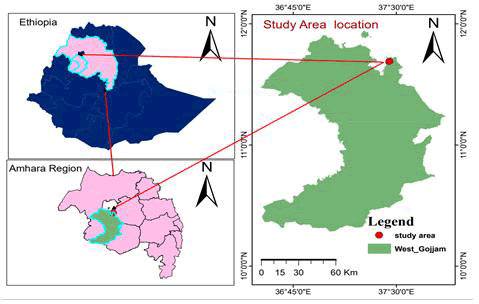
Figure 1. Map of the study area.
Site selection, land preparation and planting
The assignment web site (ILRI assignment) became selected purposely based totally on appropriate agro-ecological conditions for forage development. After choosing the website, the land turned into cleared of weeds and undesirable debris, then ploughed 3 instances through oxen and harrowed to a first-rate tilth earlier than planted, plots and blocked were outlaid. After proper land instruction, Brachiaria decumbens-10871 become planted in rows on well-organized soil via the usage of the root-splitting technique. The planting technique became two-thirds of the root splits were buried at an intensity of 10-15 cm, and the apical 1/3 become left at the ground [7] and weeds loose at some point of the experimental length with the aid of manual weeding for every 12 months as necessary. The experiment became performed for 2 consecutive years (2021 and 2022).
Fertilizer collection, analysis and application
Cattle manure become purchased from Robit Bata kebele farmers, even as urea fertilizer was bought from the Bahir Dar city nearby market. The cattle manure used inside the test had a moisture (47%), pH (7.4), general nitrogen (TN) (1.5%), natural carbon (OC) (17.5%) and to be had phosphorus (Pav) (32.8 mg/kg) properties.
At the same day, manure and synthetic fertilizer had been manually implemented to the surface. Split applications of fertilizer have been encouraged, as the increase response is more in the duration without delay following the application of fertilizer [8]. Urea fertilizer software, wherein one 1/2 turned into applied on the time of planting and the last half of became applied for 2nd harvesting, even as for manure, wherein about 2/3 changed into implemented on the time of planting and the final 1/3 changed into carried out for second harvesting due to the sluggish release of vitamins. Inside the second year, the equal amount of urea and manure was carried out at the begin of the rain after the uniform cutting of all of the plots as in the first 12 months.
Experimental treatments
The examine turned into performed underneath a 4 x 2 factorial arrangement in a randomized whole block layout (RCBD) with 3 replications. The remedies had been composed of manipulate and not using a fertilizer, 30 tons/ha livestock manure, 100 kg N/ha and 300 kg N/ha, on Brachiaria decumbens-10871 turned into observed over production years (2021 and 2022). The experiment has four treatments, 12 experimental plots and the character plot size of 9 m2 (3 m x 3 m). The distance between the plot and block turned into 1 m and 1.5 m, respectively. The spacing among rows and plants changed into 0.5 m x 0.25 m [9]. There were seven (7) rows in keeping with plot and 12 flowers according to row. The remedies had been assigned randomly into plots inside each replication.
Morphological parameter sampling and data collection methods
The samples have been gathered year-round for 2 consecutive years. At the same day, harvests had been made 2 instances per year through hand using a sickle, leaving a stubble peak of 5-10 cm from the soil to allow for extra growth of recent shoots [10]. In every plot, ten flora had been randomly selected to report the plant peak, wide variety of tillers in step with plant, quantity of leaves per plant, leaf length in step with plant and leaf width in line with plant. Sparkling biomass yield (kg), dry count number yield (t/ha), and leaf to stem ratio had been additionally decided.
Plant Height (PH) (cm)
The plant top was measured on the number one shoot from the soil surface (base) to the top of the top leaves of the principle stem by means of the usage of a measuring tape. The imply plant top from every treatment become decided via measuring the height of ten randomly decided on plant life from the center rows of each plot, leaving the outer edge rows because of the border effect and then the common height became calculated.
Number of Tillers per Plant (NTPP)
The number of tillers per plant was recorded by counting all shoots that arise from the main plant and excluding the main shoot from which the shoots arise. The number of tillers per plant was counted from the same-tagged ten randomly selected plants from the middle rows and then the mean was calculated.
Number of Leaves per Plant (NLPP)
The number of leaves per plant was counted from all tillers, including the main shoot by taking ten randomly selected plants from the middle rows. By multiplying the NLPT by the NTPP, the total NLPP was obtained and then the mean number of leaves per plant was calculated.
Leaf length per plant (cm)
The leaf length per plant was measured from the base of the collar region of the leaf to the tip of fully expanded leaves. It was measured from ten randomly selected sample plants in the middle rows by using a meter.
Leaf width per plant (cm)
The leaf width per plant was measured from the middle region of the leaf. It was measured from ten randomly selected sample plants from the middle row by using a meter.
Leaf-to-Stem Ratio (LSR)
The leaf–to-stem ratio was determined by manually separating sub-samples into leaves and stems, and weighed separately for leaf and stem. The dried sample of each component was weighed and LSR was calculated as the ratio of the dry weight of leaves (g) to the dry weight of stems (g).
Sampling methods for fresh biomass and Dry Matter Yield (DMY) (t/ha)
The plot size of each treatment was 9 m2 and from each plot, five middle rows (2nd, 3rd, 4th, 5th and 6th) with a net harvestable area of 4 m2 per plot by considering border effects, which left 50 cm lengthwise from each side. A fresh biomass yield of grass was measured immediately after harvesting and weighed on the field soon after mowing using a portable balance with a sensitivity of 0.01 g. The dry matter percentage was determined by taking about 500 g (weighted by a field sensitive balance) of sub-samples of fresh weight from each plot and chopped into short lengths (2-5 cm) and then packed with an airtight bag and subjected to oven drying at 65ºC for 72 hours to estimate the dry matter yield (ton/ha). The dry matter percentage was determined by dividing the dry weight of the subsample by the weight of the fresh subsample and multiplying by 100.
DMY (t/ha)=(10 x TFW x SSDW)/(HA x SSFW)
Where, 10 is constant for conversion of yields in kg/m2 to tone/ha; TFW is Total Fresh Weight from harvesting area (kg); SSDW is Sub-Sample Dry Weight (g); HA is Harvestable Area (m2) and SSFW is Sub-Sample Fresh Weight (g).
Partial budget analysis
The information on all variable costs related to the cost of manure and urea fertilizer was recorded during the purchasing at Robit Bata Kebele farmers and Bahir Dar City local market, respectively. The biomass yield of each treatment was recorded in each production year. The purchased price of manure per quintal was 6,000 birr for each year, while the price of urea was 1,800 and 4,500 birr per quintal in 2021 and 2022 at Bahir Dar City during our experimental periods, respectively. To estimate the price of fresh grass, the farmer estimate 1 kg of grass by 4.03 birr. The partial budget analysis was employed using the procedure recommended by CIMMYT.
Adjusted DM Yield (ADMY): The farmers using the same technologies would obtain yields 10% less than those obtained by the researchers would. ADMY=Biomass yield–(biomass yield × 0.1)
Gross Benefit (GB)=Adjusted dry matter yield × field/farm gate price for the grass
Total Variable Costs (TVC): This was calculated as the sum of all variable costs for a particular treatment.
Net Benefit (NB)=Gross field benefit–total variable cost
Dominance analysis (D): This was carried out by first listing the treatments in order of increasing costs that vary or increasing net benefits. Any treatment that has net benefits that are less or equal to those of a treatment with lower costs that vary is dominant.
Marginal Rate of Return (MRR)=(ΔNR/ΔTVC) × 100
Statistical data analysis
Data on biomass yield and morphological characteristics were subjected to Analysis of Variance (ANOVA) using the general linear model procedure in Statistical Analysis Software. When treatment means showed significant differences, Duncan’s Multiple Range Test (DMRT) significant difference test at P<0.05 was used.
The statistical model for the analysis of the data was:
Yijk=μ+Fi+Yj+Fi*Yj+Eijk
Where; Yijk is the all dependent variables (morphological data and DM yield), μ is the overall mean, Fi is the fixed effect of ith fertilizer levels (i=0, 30 t/ha cattle manure, 100 kgU/ha and 300 kgU/ha), Yj is the random effect of jth production years (j=1st year and 2nd year, Fi*Yj is the interaction effect between fertilizer application and production years and Eijk is the residual error.
Effect of fertilizer levels and years on morphological characteristics and dry matter yield
Plant Height (PH) (cm)
The interaction effects of fertilizer rate and production years had a very high significant (P<0.001) effect on the plant height (Table 1). The highest PH (61.93 and 102.33 cm) was measured at application of manure fertilizer in the first and second years, respectively. The shortest PH (42.57 and 57.3 cm) was recorded from unfertilized plot in the first and second years, respectively, with the overall mean of 69.37 cm. This might be due to the reason, the application of manure to improves soil nutrient availability (Organic Matter (OM), Total Nitrogen (TN), dissolved Organic Carbon (OC) and Ammoniam (NH4+) contents) which are necessary for plant growth. In the current result, the PH at manure >300 kg>100 kg N>0 application of fertilizer levels and types in both years. The interaction result revealed that for 0, 100, 300 kg N/ha and manure fertilizer, the maximum PH recorded in year 2 compared to year 1. The significant difference of PH across the experimental years suggests that the different distribution of rainfall, temperature. This result was consistent with the finding of Walie et al., who conducted a research on desho and Napier grass at Guder watershed that the PH of second year (75.3 cm) taller than the first year (55.5 cm).
Number of Tillers Per Plant (NTPP) (counts)
The result of the current study showed that there was very highly significant (P<0.001) effect of fertilizer rate and production years on the NTPP (Table 1). The maximum number of tillers per plant (30.67 and 120.53) were counted at manure fertilizer in the first and second years, respectively. Whereas, the minimum number of tillers (15.4 and 24) was observed from unfertilized plot in the first and second years, respectively, with the overall mean of 51.94. The more NTPP were produced from cattle manure applied in both years, due to the addition of manure can increase the growth of tillers and improve the structure of the soil to become more crumb by increasing the root growth of the soil pores. In the current study, the NTPP at manure >300 kg>100 kg N>zero application of fertilizer levels and types in both years. This current result was in line with Bedeke et al., who indicated that there was a significant (P<0.05) difference on the NTPP of desho grass increased from 54.6 to 79.6 as the fertilizer levels increased from 100 to 350 kg N/ha. The NTPP increased when the production years was extended. This study was in line with Walie et al., who reported that the mean NTPP increased when the production years extended, which in the 2018 (36.3) lower than 2019 (95.9) at Aba Gerima watershed.
Number of Leaves Per Plant (NLPP) (counts)
The interaction effect of fertilizer application and production years had a very highly significant (P<0.001) effect on the NLPP (Table 1). The maximum NLPP (172.75 and 527.08) was recorded from manure in the first and second years, respectively, while the minimum NLPP was obtained from (138.12 and 154.2) without application of fertilizer in the first and second years, respectively, with the overall mean of 276.45. In the current study, the higher NLPP was recorded from fertilized grass as compared to unfertilized grass which is manure >300 kgN/ha>100 kgN/ha>0 in both years. This result was in line with findings of Priyadarshani et al., there were increased trends in the number of leaves with increased the levels of fertilizer application. However, this result was disagreed with Riyana et al., who showed that the manure has no significant effects on number of leaves per plant. The current finding of the NLPP of second year higher than 1st year in respective fertilizer treatment, this was in agreement with with Ajema et al., who reported that the NLPP of desho grass increased when the production years extended.
Leaf Length Per Plant (LLPP) (cm)
The interaction between fertilizer application and production years had a very highly significant (P<0.001) effect on the LLPP (Table 1). The longest length of leaves per plant (17.51 and 45.17 cm) was recorded from manure application of fertilizer in the first and second years, respectively, while the shortest (12.75 and 15.95 cm) was obtained from without application of fertilizer in the first and second years, respectively, with an overall mean of 19.18. In the current study, the longer length of leaf was obtained from fertilized grass as compared to unfertilized grass. This result was in line with Mihret et al., longer LLPP of desho grass was recorded at NPS (30.48 cm) and manure (27.37 cm) than without fertilizer (19.87 cm). The present finding of LLPP in year 2 at 0, 100 kg, 300 kg N/ha and manure fertilizer levels and types were longer than year 1 in their respective fertilizer levels and types. However, this result was disagree with Ajema et al., who reported that the LLPP in year 1 (41.87 cm) was longer than year 2 (31.54 cm).
Leaf Width Per Plant (LWPP) (cm)
The interaction between fertilizer rate and production years had shown very a highly significant (P<0.001) effect on the LWPP (Table 1). The widest leaf width per plant (1.58 and 3.93 cm) was recorded from manure fertilizer application in the first and second years, respectively, whereas the narrowest leaf width (1.26 and 3.4 cm) was recorded from without fertilizer in the first and second years, respectively. The second year at all fertilizer type and level applied had wider LWPP than the first year.
Leaf to Stem Ratio (LSR)
The interaction of fertilizer levels and production years had a very highly significant (P<0.001) effects on the LSR (Table 1). The highest leaf to stem ratio (1.15 and 1.18) was measured from manure fertilizer in the first and second years, respectively, whereas the lowest LSR (0.68 and 0.88) was observed from control in the first and second years, respectively. The overall mean value of the current results was 1.03, which means, the dry weight of the leaf was greater than the dry weight of stem of grasses. Number leaf per tiller, leaf length, leaf width, and tiller number is the most important characteristics used to determine the leaf to stem ratio and forage quality. The leaf fraction has significant implications for the nutritive quality of the forage, as leaves contain higher levels of nutrients and less fiber than stems.
Dry Matter Yield (DMY) (t/ha)
The interaction effect of fertilizer rate and production years on dry matter yield in this study was highly significant (P<0.001) effect (Table 1). The highest dry matter yield (7.72 and 11.43 t/ha) was recorded from manure application in the first and second years, respectively, while the lowest DMY (5.88 and 9.23 t/ha) from without fertilizer in the first and second years, respectively. The superior DMY (t/ha) was recorded from manure fertilizer reflects that the ability of grass which is rapidly regenerate, increasing in plant height, number of leaves per tiller, number of tillers per plant and other morphological parameters of grass could be increasing forage yield. In the current study, the DMY (t/ha) increased from 0 to 100 to 300 kgN/ha and manure in both years. This result was in line with Bedeke et al. indicated that DMY of desho grass was increased from 8.32 to 13.6 t/ha as the fertilizer level increased from 100 to 250 kg N/ha. The current result of DMY increase as the production year extended. The second year at all fertilizer type and level applied had more DMY than the first year with its respective fertilizer type and level. This result was agreed with Hidosa et al. reported that the higher DMY of desho grass varieties was recorded in 2018 (24.44 t/ha) than in 2017 (14.74 t/ha). This could be attributes to the genetic potential of grass adapting to the tested environmental factors such as soil characteristics, moisture, and temperature over a year.
| Factors | Parameters | |||||||
| Fertilizer rate | Years | PH | NTPP | NLPP | LLPP | LWPP | LSR | DMY (t/ha) |
| Control | 2021 | 42.57e | 15.40j | 154.20f | 12.75c | 1.26h | 0.68g | 5.88e |
| 100 kg N | 2021 | 57.30de | 27.60def | 167.04e | 13.57c | 1.54g | 0.88f | 6.76de |
| 300 kg N | 2021 | 58.50d | 28.27def | 172.70e | 14.11d | 1.58f | 1.11d | 7.26d |
| Manure | 2021 | 61.93cd | 30.67def | 172.75e | 17.51c | 1.60e | 1.15b | 7.72d |
| Control | 2022 | 57.30de | 24.00d | 138.12d | 15.95bc | 3.40d | 0.88f | 9.23c |
| 100 kg N | 2022 | 73.33b | 75.47c | 394.50c | 16.51bc | 3.71c | 0.96e | 10.13b |
| 300 kg N | 2022 | 101.67a | 93.60b | 485.17b | 17.87bc | 3.84b | 1.12c | 10.77ab |
| Manure | 2022 | 102.33a | 120.53a | 527.08a | 45.17a | 3.93a | 1.18a | 11.43a |
| Overall mean | 69.37 | 51.94 | 276.45 | 19.18 | 2.61 | 1.03 | 8.65 | |
| SEM ± | 7.26 | 13.92 | 8.57 | 9.9 | 0.003 | 0.002 | 0.77 | |
| CV% | 5.79 | 7.23 | 0.94 | 8.45 | 1.92 | 3.64 | 7.65 | |
| R2 | 0.99 | 0.99 | 0.99 | 0.98 | 0.99 | 0.99 | 0.98 | |
| Frt*yr | <.0001 | <.0001 | <.0001 | 0.0104 | <.0001 | <.0001 | <.0001 | |
Table 1. Interaction effect of fertilizer application and years on morphological parameters and DMY.
Partial budget analysis
The overall partial budget analysis of the current study was presented in Table 2 for 1st year and Table 3 for 2nd year). The highest net benefit (22000.44 birr) in the first year was obtained from at manure, while the lowest net benefit was recorded from 300 kg (20915.9 birr) (Table 2). Similar with year 1, the highest net benefit in the second year was obtained at manure-fertilized plot (35456.61 birr) (Table 3). Generally, the higher net benefit was obtained from manure fertilizer than others and the second year had the higher net benefit than year 1.
| Descriptions | Fertilizer type and levels (Treatments) | |||
| Control | 100 kg urea | 300 kg urea | Manure | |
| DMY (Kg) | 5880 | 6760 | 7260 | 7720 |
| ADMY (Kg) (A) | 5290 | 6080 | 6530 | 6948 |
| Cost of urea | 0 | 1800 | 5400 | 0 |
| Cost of manure | 0 | 0 | 0 | 6,000 |
| TVC (B) | 0 | 1800 | 5400 | 6,000 |
| Grass price (birr/ kg) (C) | 4.03 | 4.03 | 4.03 | 4.03 |
| Gross benefit (A*C) (D) | 21318.7 | 24502.4 | 26315.9 | 28000.44 |
| Net benefit (D-B) (birr) | 21318.7 | 22702.4 | 20915.9 | 22000.44 |
| Change in TVC (TVC) | 0 | 1800 | 5400 | 6000 |
| Change in net benefit (NR) | 0 | 1473.7 | -402.8 | 681.74 |
| MRR (%)=(NR/TVC)*100 | ND | 8.19 | D | 11.36 |
Table 2. Partial budget analysis of different fertilizer level and type on Bracharia decumbens grass variety in year 1.
| Descriptions | Fertilizer type and levels (Treatment) | |||
| Control | 100 kg urea | 300 kg urea | Manure | |
| DMY (Kg) | 9230 | 10130 | 10770 | 11430 |
| ADMY (Kg) (A) | 8307 | 9117 | 9693 | 10287 |
| Cost of urea ETB Kg-1 | 0 | 4500 | 13500 | 0 |
| Cost of manure in ETB Quintal-1 | 0 | 0 | 0 | 6000 |
| TVC (B) | 0 | 4500 | 13500 | 6000 |
| Grass price (birr/kg) (C) | 4.03 | 4.03 | 4.03 | 4.03 |
| Gross benefit (A*C) (D) | 33477.21 | 36741.51 | 39062.79 | 41456.61 |
| Net benefit (D-B) (birr) | 33477.21 | 32241.51 | 25562.79 | 35456.61 |
| Change in TVC (TVC) | 0 | 4500 | 13500 | 6000 |
| Change in net benefit (NR) | 0 | -1234.7 | -7914.42 | 1979.4 |
| MRR (%)=(Δnr/ΔTVC)*100 | ND | D | D | 31.96 |
Table 3. Partial budget analysis of different fertilizer level and type on Bracharia decumbens grass variety in year 2.
The interaction effects of fertilizer application and production years had significant (p<0.001) effect on morphological characteristics, and dry matter yield observed in this study. The morphological characteristics and DMY increased as the level of fertilizer increased and the production year also extended. The highest PH, NTPP, NLPP, LLPP, LWPP, LSR and DMY were obtained from manure fertilizer application in both years. Based on this evaluation, Brachiaria decumbens-10871 with manure fertilizer application was recommended due to adaptive and better production performance to fulfill the shortage of forage quantity to enhance the livestock production and productivity in the study area and similar agro ecologies.
I would like to give my deepest thanks ILRI Project for granting my study which covers laboratory analysis expenses.
There is no conflict of interest.
The data used for analysis will be available from the corresponding author on request.
[Crossref] [Google Scholar] [PubMed]