
Journal of Global Research in Computer Sciences
 Menu
MenuISSN: 2229-371X
ISSN: 2229-371X
Suraj Tiwari*
Department of Computer Science and Engineering, Central Institute of Technology, Kokrajhar, India
Received: 19-Oct-2024, Manuscript No. GRCS-24-150473; Editor assigned: 22-Oct-2024, Pre QC No. GRCS-24-150473 (PQ); Reviewed: 05-Nov-2024, QC No. GRCS-24-150473; Revised: 05-Sep-2025, Manuscript No. GRCS-24-150473 (R); Published: 12-Sep-2025, DOI: 10.4172/2229-371X.16.3.001
Citation: Tiwari S. Analysing Temperature Anomalies in India: Projections and Trends Using CMIP6 Models Outputs. RRJ Glob Res Comput Sci. 2025;16:001.
Copyright: © 2025 Tiwari S. This is an open-access article distributed under the terms of the Creative Commons Attribution License, which permits unrestricted use, distribution and reproduction in any medium, provided the original author and source are credited.
Visit for more related articles at Journal of Global Research in Computer Sciences
India, characterized by its diverse climatic and geographic conditions, lacks a comprehensive analysis of temperature anomalies across its regions. Research on localized temperature dynamics and its consequences for certain regions and socioeconomic groups is needed. This study provides a comprehensive overview of the past and projected variations in temperatures in India between 1965 to 2064 using coupled model inter comparison project phase 6 climate models. Significant warming trends are indicated by future temperature forecasts under four SSP (Shared Socioeconomic Pathways) scenarios: SSP 1-2.6, SSP 2-4.5, SSP 3-7.0, and SSP 5-8.5 were found in this study. According to spatial study, the regions of northern India, especially those close to the Himalayas, likely to have large temperature anomalies, with maximum temperatures expected to exceed 4°C and mean temperatures exceeding 3.5°C under SSP 5-8.5 in the future. The central and southern regions will also experience noticeable, though smaller, temperature increases. The long-term estimates indicate that by 2064, the mean temperature anomalies will be increases roughly by 1.5°C under SSP 1-2.6, 2.0°C under SSP 2-4.5, 2.5°C under SSP 3-7.0, and over 3.0°C under SSP 5-8.5 in this study. Under SSP 1-2.6, maximum temperature anomalies are expected to rise by about 1.7°C, by 2.2°C under SSP 2- 4.5, by 2.6°C under SSP 3-7.0, and nearly 3.0°C under SSP 5-8.5. Minimum temperature anomalies are projected to increase by 1.5°C under SSP 1-2.6, by 2.0°C under SSP 2-4.5, by 2.5°C under SSP 3-7.0, and almost 3.5°C under SSP 5-8.5.
Bias correction; Climate projections; Temperature anomalies; Shared Socioeconomic Pathways (SSP); General Circulation Models (GCMs); India climate change
Temperature serves as a vital climate metric, directly impacting both human activities and natural ecosystems. The global mean surface temperature is a critical climate change indicator that rises quasi-linearly with cumulative greenhouse gas emissions. This has been highlighted in several assessment reports published by the Intergovernmental Panel on Climate Change (IPCC), the most recent of which is the Fifth assessment report [1]. Since pre-industrial times, the Earth's average temperature has surged by approximately 1°C, a swift escalation attributed primarily to human-induced activities. Notably, emissions of Greenhouse Gases (GHGs), aerosols, and alterations in land use and cover during the industrial era have substantially reshaped atmospheric composition, thus disrupting the planet's energy balance and driving contemporary climate change [2]. The warming trend since the 1950’s has spurred a heightened frequency of extreme weather events globally, encompassing heatwaves, droughts, heavy precipitation, and severe cyclones. Moreover, it has spurred notable alterations in precipitation patterns, wind dynamics, and the state of the world's oceans, including warming, acidification, melting sea ice and glaciers, rising sea levels, and consequential changes in marine and terrestrial ecosystems [3]. This study conducts a comprehensive spatial and temporal trend analysis of annual, monthly, and seasonal maximum and minimum temperatures (tmax, tmin) across India. Recent in extreme temperatures for various time slots (1901-2003, 1948-2003, and 1970-2003) are scrutinized, relying on estimates derived from the India Meteorological Department's (IMD) gridded monthly station data [4]. The analysis encompasses references to prior studies exploring temperature trends across India. Focusing on the more recent three decades (1986-2015), assessments based on IMD's gridded daily station data reveal a pronounced warming trend across India. Notable increases in annual mean, maximum, and minimum temperatures are evident, indicating rises of 0.15°C, 0.15°C, and 0.13°C per decade respectively, with a high level of confidence. Particularly significant warming is noted during the pre-monsoon season within this 30-year timeframe. Additionally, it is highly probable that both annual and seasonal near-surface air specific humidity have experienced an uptick across India since the 1980’s [4].
Materials and Methods
Data
The European environment agency’s (ERA5): The European environment agency's ERA5 [5] dataset stands as a pivotal resource for climate scientists and researchers globally. ERA5 is the fifth generation of the European Centre for Medium-Range Weather Forecasts (ECMWF) Reanalysis, providing high-resolution and consistent climate data spanning several decades. For history data year for analysis the surface temperature where taken is 1964 to 2014 and converted in 0.25° × 0.25° grid for whole India where 4964 points in India region. Produced by the European Centre for Medium-Range Weather Forecasts (ECMWF) and available through the Copernicus Climate Change Service (C3S), the dataset includes key atmospheric variables such as daily mean temperature (Tmean), maximum temperature (Tmax), and minimum temperature (Tmin). From the total number of climate models listed under CMIP6 on the Earth system grid website, we have selected only six models from key research groups worldwide. These groups include ACCESS, IPSL, MIROC6, among others, which significantly contribute to the CMIP model simulations for evaluation, validation, and assessment. The climate models considered in this study under CMIP6, encompassing both the historical experiment (1964-2014) (50 years) and the shared Socioeconomic Pathways (SSPs) for four scenarios: SSP1-2.6, SSP2-4.5, SSP3-7.0, and SSP5-8.5. The data has been downscaled to a resolution of 0.25°× 0.25° for the entire region of India, covering a total of 4964 grid points, with daily temperature data for Tmean, Tmax, and Tmin for the years 2015-2064 (50 years).
Study area
India’s study area spans from approximately 6°N to 37°N latitude and 68°E to 97°E longitude. It encompasses a wide range of climates and geographical features. In the north, the Himalayan mountain range dominates, with temperate climates and cold winters. The southern regions experience tropical weather, high humidity, and monsoons. Central India has a wet and dry tropical climate, while the West (including Rajasthan) is arid. The East (West Bengal, Odisha) has a humid subtropical climate. Annual mean temperatures vary across the study area. Cooler temperatures prevail in the Northern mountains, while Central and Southern regions experience higher temperatures. This diverse region provides valuable insights for climate change analysis and adaptation strategies. 4964 total points and homogeneous regions used in the present study (Figure 1). WH: Western Himalaya; NW: Northwest; NE: Northeast; NC: North Central; EC: East Coast; WC: West Coast; IP: Interior Peninsula.
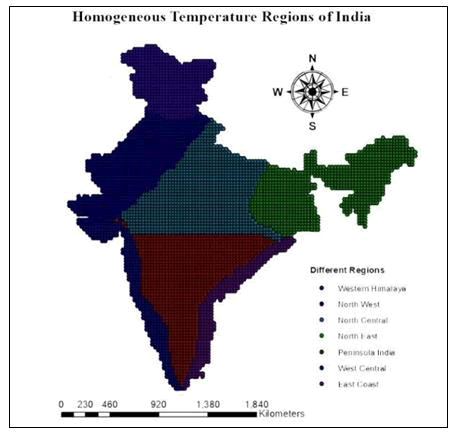
Figure 1. 4964 total points and homogeneous regions used in the present study.
Methods
The methodos employed in this study is designed to comprehensively analyse and project future temperature in India from 2015 to 2064. This approach integrates advanced statistical techniques, climate model simulations, and downscaling methods to generate robust temperature projections under various Shared Socioeconomic Pathways (SSPs). The key steps of the methodology include data collection, cleaning, downscaling, bias correction, and ensemble modelling, culminating in detailed analyses of temperature anomalies and spatial patterns. Data collection for this study involved gathering information from two main sources: ERA5 re-analysis data and CMIP6 climate model data. These datasets encompassed historical records spanning from 1965 to 2014 and future projections extending from 2015 to 2064. The variables considered included mean temperature (Tmean), maximum temperature (Tmax), and minimum temperature (Tmin). In the data preparation phase, the raw datasets underwent downscaling using CDO software to achieve a high-resolution grid of 0.25°× 0.25°. This process aimed to enhance spatial detail and accuracy. Additionally, data cleaning procedures were implemented to ensure consistency across the historical and future datasets, aligning them with specific year ranges. To address potential systematic biases in the model outputs, Quantile Delta Mapping (QDM) and Equidistant Cumulative Distribution Function (EDCDF) methods were applied using MATLAB software in the bias correction step. Subsequently, a Mean Model Ensemble (MME) was constructed for selected models, including ACCESS-CM2, ACCESS-ESM1-5, AWI-CM-1-1MR, EC-EARTH3, MIROC6, and IPSL-CM6A-LR. This ensemble approach aimed to improve the robustness of the projections by considering multiple model outputs. The analysis phase involved several steps. First, spatial patterns of both observed data and MME simulated data were analysed for the reference period of 1964-2014 to assess model performance. Next, future temperature anomalies were examined to understand regional variations and potential impacts of climate change across India from 2015 to 2064. The study also projected future temperature anomalies based on the MME under different Shared Socioeconomic Pathways (SSPs), providing insights into potential future climate scenarios. Lastly, projections for maximum and minimum temperatures were analysed to evaluate extreme temperature events and their potential frequency and intensity over the same period.
Analysis of spatial patterns of temperature anomalies for India (2015-2064)
The spatial patterns of temperature anomalies for the India region relative to the reference period 1965-2014. These projections are based on the Mean Model Ensemble (MME) of six General Circulation Models (GCMs) under four SSP-RCP scenarios: SSP1-2.6, SSP2-4.5, SSP3-7.0, and SSP5-8.5. The figures illustrate changes in mean temperature (tmean), maximum temperature (tmax), and minimum temperature (tmin) across different latitudes and longitudes.
This Figure 2 shows the spatial distribution of mean temperature anomalies under four SSP scenarios. Figure 2(a) SSP1-2.6, (b) SSP2-4.5, (c) SSP3-7.0, (d) SSP5-8.5. Across all scenarios, northern India (particularly the regions close to the Himalayas) shows the highest increase in mean temperature anomalies. SSP1-2.6 Shows the least warming, with temperature anomalies generally below 2°C. SSP2-4.5 indicates moderate warming, with anomalies mostly between 2°C and 3°C. SSP3-7.0 displays higher anomalies, ranging from 2.5°C to 3.5°C. SSP5-8.5 exhibits the most significant warming, with anomalies often exceeding 3.5°C, especially in northern regions.
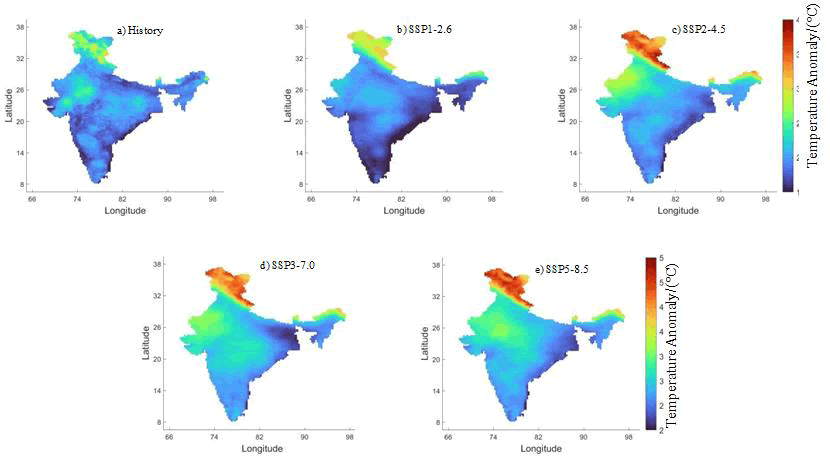
Figure 2. Anomaly spatial patterns of Mean temperature changes relative to the reference period (1965– 2014) (a), under MME 6 models of SSP1-2.6 (b), SSP2-4.5 (c), SSP3-7.0 (d) and SSP5-8.5 (e).
This Figure 3 illustrates the spatial distribution of maximum temperature anomalies under four SSP scenarios. Like the mean temperature, the northern regions show more pronounced increases in maximum temperatures. SSP1-2.6 Shows the smallest increase in maximum temperatures, generally under 2.5°C. SSP2-4.5 displays moderate increases, with anomalies typically between 2.5°C and 3.5°C. SSP3-7.0 indicates higher maximum temperature anomalies, ranging from 3°C to 4°C. SSP5-8.5 shows the largest increases, with anomalies often exceeding 4°C, particularly in the north and northwest regions.
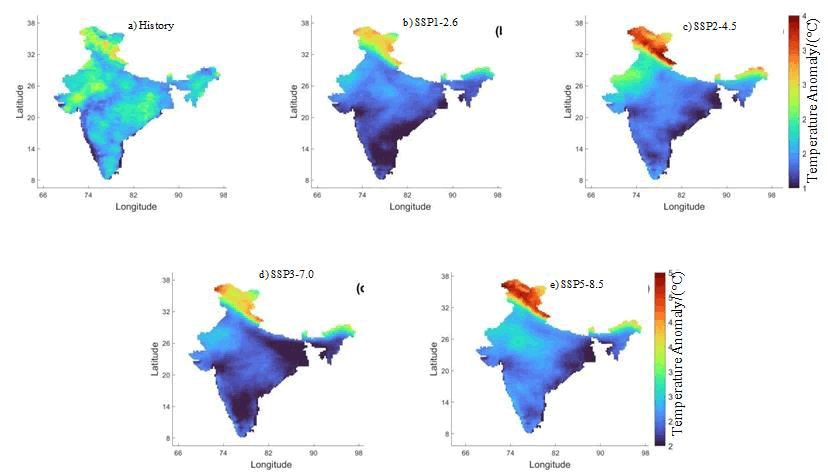
Figure 3. Anomaly spatial patterns of maximum temperature changes relative to the reference period (1965–2014) (a) under SSP1-2.6 (b), SSP2-4.5 (c), SSP3-7.0 (d) and SSP5-8.5 (e).
This Figure 4 presents the spatial distribution of minimum temperature anomalies under four SSP scenarios. The spatial patterns are like mean and maximum temperature changes, with northern regions experiencing greater increases. SSP1-2.6 indicates the least warming for minimum temperatures, generally under 2°C. SSP2-4.5 shows moderate increases, with anomalies mostly between 2°C and 3°C. SSP3-7.0 displays higher anomalies, ranging from 2.5°C to 3.5°C. SSP5-8.5 exhibits the largest increases, with anomalies often exceeding 3.5°C, especially in northern India.
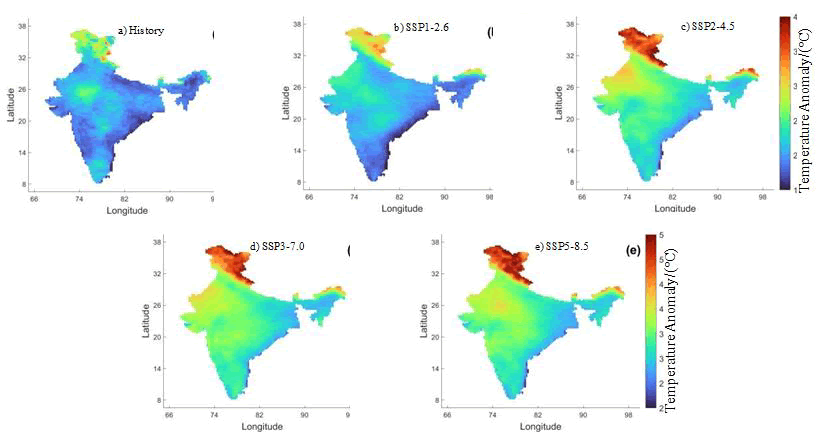
Figure 4. Anomaly spatial patterns of minimum temperature changes relative to the reference period (1965-2014) in (a) under SSP1-2.6 (b), SSP2-4.5 (c), SSP3-7.0 (d) and SSP5-8.5 (e).
Discussion of temperature changes across the region
Northern India: The Northern latitudes, especially those near the Himalayas, consistently show the highest temperature anomalies across all scenarios. This region is particularly sensitive to climate change due to its elevation and existing climatic conditions. Central India: Exhibits moderate temperature increases, with anomalies generally between those observed in the North and South [6]. Southern India: Shows smaller increases in temperature anomalies compared to Northern and central India. The anomalies are more pronounced under higher emission scenarios but remain lower than in the North.
Projected temperature anomalies in India under various SSP’s scenarios (1965-2064)
These three figures display anomaly temporal changes in annual mean temperature from 1965 to 2064 under different SSP-RCP scenarios (relative to the period 1965–2014) for the India region at grid point 4964. The projections are based on a Mean Model Ensemble (MME) incorporating six General Circulation Models (GCMs). Each figure illustrates the projected temperature anomalies for mean temperature (tas), maximum temperature (tasmax), and minimum temperature (tasmin) under four SSP scenarios: SSP 126, SSP 245, SSP 370, and SSP 585. All scenarios show a clear increasing trend in temperature anomalies for mean, maximum, and minimum temperatures, indicating significant warming over the projected period.
Figure 5 a): Anomaly temporal changes in annual mean temperature (tmean) during 1965–2064 where SSP1-2.6 shows the increases gradually, reaching about 1.5°C, SSP2-4.5 shows a more noticeable increase, rising to approximately 2.0°C, SSP3-7.0 reaches around 2.5°C, and SSP5-8.5 scenario shows the highest increase, with the anomaly reaching nearly 3.0°C above the baseline by 2064. Figure 5 b) anomaly temporal changes in annual maximum temperature (tmax) during 1965–2064 here SSP1-2.6 the maximum temperature anomaly increases gradually, reaching about 1.7°C, SSP2-4.5 the anomaly shows a more substantial increase, rising to approximately 2.2°C, SSP3-7.0 the maximum temperature anomaly reaches around 2.6°C and SSP5-8.5 this scenario shows the highest increase, with the anomaly reaching nearly 3.0°C above the baseline by 2064. Figure 5 c) anomaly temporal changes in annual minimum temperature (tasmin) during 1965–2064, where SSP1-2.6 the minimum temperature anomaly increases steadily, reaching about 1.5°C, the anomaly rises more significantly, reaching approximately 2.0°C in SSP2-4.5, the minimum temperature anomaly reaches around 2.5°C at SSP3-7.0 and SSP5-8.5 this scenario shows the highest increase, with the anomaly reaching nearly 3.5°C. Higher emission scenarios (SSP3-7.0 and SSP5-8.5) show more pronounced warming compared to lower emission scenarios (SSP1-2.6 and SSP2-4.5).
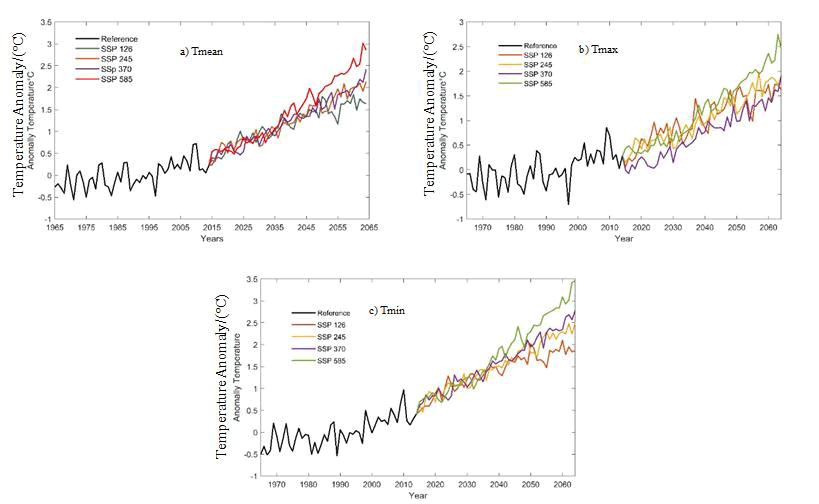
Figure 5. Projected temperature anomalies (a) Mean temperature (tmean), (b) maximum temperature (tmax) and (c) minimum temperature (tmin) in India under various SSP’s during 1965–2064 under SSPs (relative to 1965–2014).
Analysis of maximum and minimum temperature projections for India (2015-2064)
The Figure 6 provides a comprehensive overview of the projected changes in maximum and minimum temperatures across India. The results indicate a clear warming trend, with more significant increases under higher emission scenarios (SSP3-7.0 and SSP5-8.5).
Figure 6 historical (1965-2014) maximum temperatures ranged mostly from 25°C to 45°C, with the highest temperatures observed in the northwest and central regions. SSP 126 shows a slight increase in maximum temperatures, with most regions experiencing increases of 2-3°C. SSP 245 indicates a moderate rise in maximum temperatures, with anomalies around 3-4°C, particularly in the north and central areas. SSP 370 displays higher increases, with maximum temperatures rising by 4-5°C, especially in northern and western regions. And SSP 585 exhibits the most significant warming, with anomalies exceeding 5°C in many regions, particularly in the north and northwest.
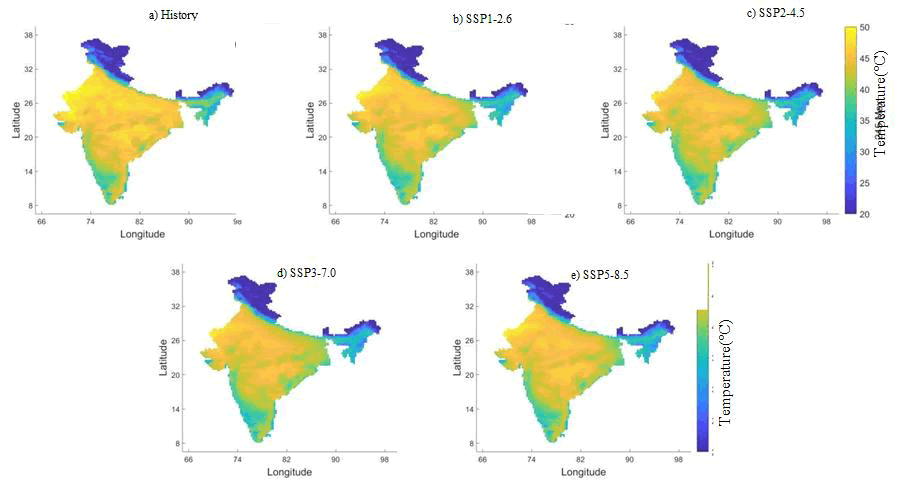
Figure 6. Mean Model Ensemble (MME) of maximum temperature in India (1965-2014) (a) and projections (2015-2064) under different SSP’s scenarios (b) SSP1-2.6, (c) SSP2-4.5, (d) SSP3-7.0 and (e) SSP5-8.5.
Figure 7 shows historical (1965-2014) minimum temperatures ranged from 10°C to 30°C, with cooler temperatures in the northern and northeastern regions. SSP1-2.6 shows a slight increase in minimum temperatures, with most regions experiencing increases of 1-2°C. SSP2-4.5 indicates a moderate rise in minimum temperatures, with anomalies around 2-3°C. SSP3-7.0 displays higher increases, with minimum temperatures rising by 3-4°C, particularly in the northern regions. Ans SSP5-8.5 exhibits the most significant warming, with anomalies exceeding 4°C in many regions, especially in the north.
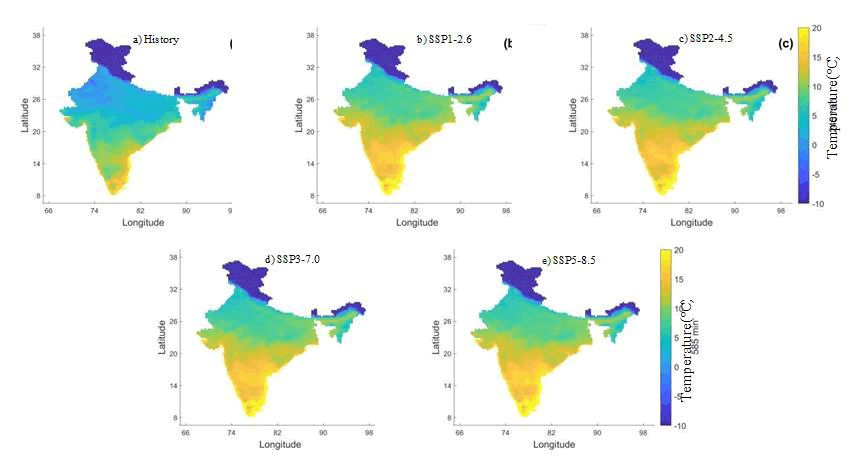
Figure 7. Mean Model Ensemble (MME) of minimum temperature in India (1965-2014) (a) and projections (2015-2064) under different SSP’s scenarios (b) SSP1-2.6, (c) SSP2-4.5, (d) SSP3-7.0 and (e) SSP5-8.5.
Higher SSP scenarios (SSP3-7.0 and SSP5-8.5) predict more substantial temperature increases across all metrics (maximum and minimum temperatures). There is clear spatial variability in the temperature anomalies, with northern India experiencing the most significant changes. This is consistent across both maximum and minimum temperature projections. These projections highlight the potential for severe climate impacts, particularly in northern regions, under higher emission scenarios. The variability across latitudes and longitudes underscores the need for region-specific adaptation and mitigation strategies to address the diverse impacts of climate change across India.
Spatial distribution and trends of temperature extremes and mean in India under various emission scenarios
Understanding the spatial distribution and trends of temperature extremes (Tmax and Tmin) and mean temperatures (Tmean) is crucial for assessing the impacts of climate change. This analysis uses Theil-Sen slopes to represent the rate of change in temperature over time across India, under both historical conditions and future projections based on different Shared Socioeconomic Pathways (SSPs). The SSPs range from low (SSP1-2.6) to very high (SSP5-8.5) emission scenarios, providing insights into how varying levels of greenhouse gas emissions influence temperature trends. The figures below illustrate these trends, highlighting regions with significant temperature increases and emphasizing the need for effective climate mitigation strategies.
Figure 8 shows the spatial distribution of Theil-Sen slopes of Tmax (maximum temperature) over India for different scenarios. The Theil-Sen slope is a robust measure of trend, indicating the rate of change in maximum temperature over time. The scenarios are historical (a) and future projections under different Shared Socioeconomic Pathways (SSPs) (b-e). Historical Trends (His) trend values for Tmax range from around 0.01 to 0.06 per year, with lower values shown in blue and higher values in yellow. Most of India shows a trend of increasing Tmax, with the north and central regions experiencing higher rates. SSP1-2.6 (low emissions scenario) this scenario represents a future with low greenhouse gas emissions and strong climate mitigation efforts. The Tmax trend shows a similar pattern to the historical data but with slightly higher increases in some areas, particularly in the northern and central regions. The trend values for Tmax range from about 0.015 to 0.04 per year. SSP2-4.5 (moderate emissions scenario) represents a middle-of-the-road pathway with moderate emissions and mitigation efforts. The trend of increasing Tmax is more pronounced compared to SSP1-2.6, indicating higher temperature increases, especially in the northern parts of India. Trend values range from about 0.02 to 0.065 per year. SSP3-7.0 (high emissions scenario) represents a future with high emissions and limited mitigation efforts. The Tmax trends are even more significant, with widespread areas in India showing substantial increases in maximum temperature. The north and central regions are particularly affected, with trend values ranging from about 0.02 to 0.07 per year. And SSP5-8.5 (very high emissions scenario) represents a future with very high emissions and minimal mitigation efforts. It shows the most significant increases in Tmax trends, with large portions of India experiencing strong warming trends. The central and northern regions are especially impacted [7]. Despite the highest emissions, the range appears somewhat like SSP3-7.0, but the spatial extent of higher values is more pronounced, with trend values ranging from about 0.02 to 0.06 per year.
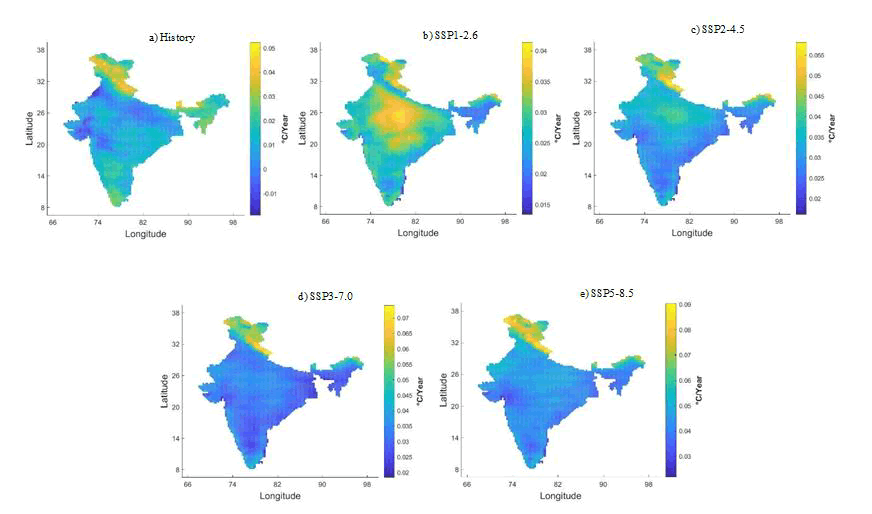
Figure 8. Spatial distribution of Theil-Sen slopes of Tmax different scenario (a) History, (b) SSP1- 2.6, (c) SSP2-4.5, (d) SSP3-7.0, (e) SSP5-8.5.
Figure 9 (a) Historical trends (His): The historical map shows that the rate of mean temperature increases ranges from about 0.005 to 0.04 per year. Areas with smaller increases are in blue, while larger increases are in yellow. The northern regions, especially the northeast, have higher trends compared to the rest of India. (b) SSP1-2.6 (low emissions scenario) under this scenario, which assumes strong climate mitigation efforts and low emissions, the trend values range from about 0.015 to 0.04 per year. These increases are higher than historical trends but still moderate. The highest trends are seen in the northern and central regions. (c) SSP2-4.5 (moderate emissions scenario) scenario represents moderate emissions and mitigation efforts, with trend values ranging from about 0.02 to 0.055 per year.
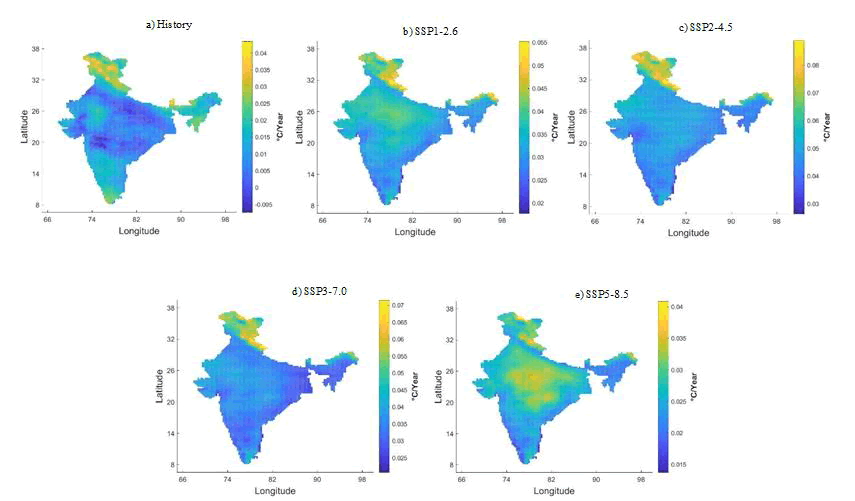
Figure 9. Spatial distribution of Theil-Sen slopes of Tmean different scenario (a) History, (b) SSP1- 2.6, (c) SSP2-4.5, (d) SSP3-7.0, (e) SSP5-8.5.
The spatial extent of higher trends is broader compared to SSP1-2.6, indicating more significant increases in mean temperature, especially in the northern and central parts of India. (d) SSP3-7.0 (high emissions scenario) high emission scenario shows more pronounced warming trends, with values ranging from about 0.025 to 0.07 per year. Northern and northeastern India exhibits strong warming trends, and there are noticeable increases across central and southern regions as well, indicating substantial warming across most of the country. And (e) SSP5-8.5 (Very high emissions scenario) this scenario, which assumes very high emissions and minimal mitigation efforts, trend values range from about 0.03 to 0.08 per year. It shows the most significant increases in Tmean, with extensive areas experiencing strong warming. The northern regions have the highest increases, but substantial warming trends are evident throughout India.
Figure 10 (a) Historical Trends (His) map shows that the rate of minimum temperature increases ranges from about 0.01 to 0.04 per year. Areas with smaller increases are in blue, while larger increases are in yellow. The northern and northeastern regions, as well as some parts of central India, show higher trends compared to the rest of the country. (b) SSP1-2.6 (low emissions scenario) this scenario, which assumes strong climate mitigation efforts and low emissions, the trend values for Tmin range from about 0.015 to 0.045 per year. These increases are higher than historical trends but still moderate. The highest trends are seen in the northern and central regions. (c) SSP2-4.5 (moderate emissions scenario) represents moderate emissions and mitigation efforts, with trend values ranging from about 0.02 to 0.055 per year. The spatial extent of higher trends is broader compared to SSP1-2.6, indicating more significant increases in minimum temperature, especially in the northern and central parts of India. (d) SSP3-7.0 (high emissions scenario): High emission scenario shows more pronounced warming trends, with values ranging from about 0.03 to 0.075 per year. Northern and northeastern India exhibits strong warming trends, and there are noticeable increases across central and southern regions as well, indicating substantial warming across most of the country. And (e) SSP5-8.5 (very high emissions scenario) this scenario, which assumes very high emissions and minimal mitigation efforts, trend values range from about 0.03 to 0.09 per year. It shows the most significant increases in Tmin, with extensive areas experiencing strong warming. The highest increases are seen in the northern regions, but substantial warming trends are evident throughout India [8].
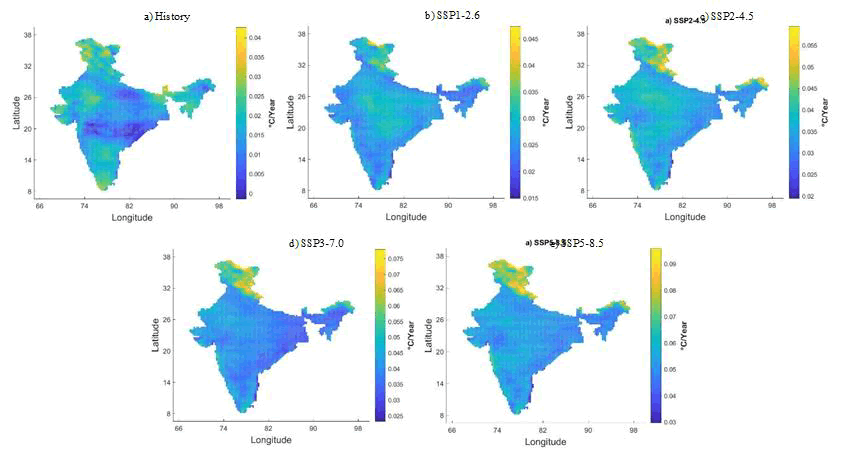
Figure 10. Spatial distribution of Theil-Sen slopes of Tmin different scenario (a) History, (b) SSP1- 2.6, (c) SSP2-4.5, (d) SSP3-7.0, (e) SSP5-8.5.
The study's analysis underscores significant projected temperature increases across India from 1965 to 2064, highlighting substantial regional variability. Using six GCMs from the CMIP6 dataset, a Mean Model Ensemble (MME) was created to simulate Tmax, Tmean, and Tmin, along with their extremes, at 4964 points on a 0.25°× 0.25° grid covering mainland India. The EDCDF method for bias correction was employed, revealing that northern India, particularly near the Himalayas, is projected to experience the highest temperature anomalies, often exceeding 3.5°C under SSP5-8.5. Central and southern India show moderate to smaller increases, respectively, with higher anomalies under more severe emission scenarios. Long-term projections indicate that by 2064, mean temperature anomalies could reach 1.5°C under SSP1-2.6, rising to nearly 3.0°C under SSP5-8.5. Maximum and minimum temperature anomalies follow similar patterns, with significant warming trends observed in the Theil-Sen slope analysis across all scenarios. These findings emphasize the critical need for robust climate mitigation strategies to address the increasing temperatures projected, especially under higher emission scenarios.
[Crossref] [Google Scholar] [PubMed]