
Research & Reviews: Journal of Material Sciences
 Menu
MenuISSN:2321-6212
ISSN:2321-6212
Shah Khalid1*, Junaid Khan2, Pagunda3, Farhan Ahmad4, Rabah Khenata5, Muhammad Yar6, Abdullah Al Souwaileh7
1Department of Energy and Materials, China University of Petroleum, Beijing, China
2Department of Physics, Khushal Khan Khattak University, Karak, Pakistan
3Department of Chemistry, University of Malakand, Khymber Phwa, Pakistan
4Department of Science and Technology, Nanjing University of Science and Technology, Jiangsu Province, China
5Laboratory of Quantum Physics of Matter and Mathematical Modeling (LPQ3 M), University of Mascara, Mascara, Algeria
6Department of Physics, Qilu Institute of Technology, Shandong, China
7Department of Electrical Engineering, Princess Nourah bint Abdulrahman University, Riyad, Saudi Arabia
*Corresponding Author:
Received: 11-Jul-2024, Manuscript No. JOMS-24-141326; Editor assigned: 15-Jul-2024, Pre QC No. JOMS-24-141326 (PQ); Reviewed: 29-Jul-2024, QC No. JOMS-24-141326; Revised: 04-April-2025, Manuscript No. JOMS-24-141326 (R); Published: 11-April-2025, DOI: 10.4172/2321-6212.13.2.002
Citation: Khalid S, et al. Experimental Investigation of the Structural, Electrical and Magnetic Properties of AgNbO3 Silver Nanobytes. RRJ Mater Sci. 2025;13:002.
Copyright: © 2025 Khalid S, et al. This is an open-access article distributed under the terms of the Creative Commons Attribution License, which permits unrestricted use, distribution and reproduction in any medium, provided the original author and source are credited.
Visit for more related articles at Research & Reviews: Journal of Material Sciences
We studied the structural, electrical and magnetic properties of pure and Li-doped AgNbO3 by using X-ray diffraction and a first-principles study. An analysis of X-ray diffraction shows that Pure AgNbO3 at room temperature has an orthorhombic structure with the Pmc2 symmetry space group. However, X=0 Li-doped AgNbO3 is orthorhombic with Pb cm symmetry, and the X=0.5 symmetry structure is trigonal with R3c symmetry. Scanning Electron Microscopy (SEM) indicates that all the ceramics have a nearly homogeneous composition and negligible influence of lithium concentration on sample porosity. Polarization vs. field curves show that for x=0, AgNbO3 (AN) is less ferroelectric, while the addition of 0.05% Li concentration to AN shows signs and no switchable evidence of linear ferroelectricity, the investigated properties showed that our material may have good optoelectronics applications.
Structural properties; Magnetic properties; Ferroelectricity; Piezoelectricity; Polarization
AgNbO3 has attracted great interest in Piezo- and ferroelectricity, because of its substantial electromechanical response [1], for applications in sensors, imaging devices, accelerometers, actuators, filters, resonators and phase shifters. AgNbO3 is also used as a photocatalytic material for cleaning in hydrogen production [2].
AgNbO3 is an important perovskite niobate [3]. Many researchers have found that the crystal structure of AgNbO3 at room temperature is orthorhombic [4]. It has a simple formula, but a complex sequence of M1, M2 and M3 phase transitions was investigated by Sciau et al. [5]. Recently, it was reported that AgNbO3 exhibits a series of structural and phase transitions (Figure 1). At a high temperature (T>660 K), phases are formed due to the tilting of NbO6 octahedra with a small A-site ion Ag+, and they are fairly well understood [3]. At low temperature (T<626 K), M1, M2 and M3 are orthorhombic with monoclinic distortion due to Ag and Nb cation displacement [3,6].
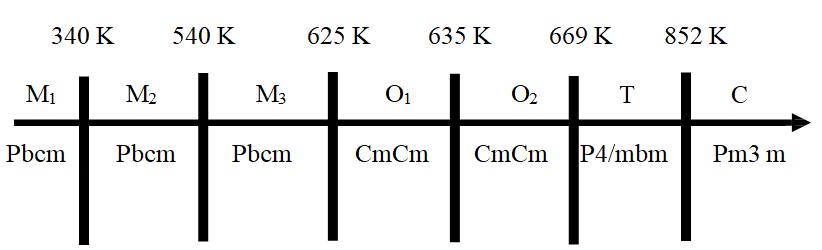
Figure 1. Structural phase transitions, space groups, and Glazer notations in AgNbO3.
O1 and O2 are the phases with orthorhombic symmetry and T and C indicate tetragonal and cubic structures, respectively [5,7]. It was also established that the M1 phase exhibits weak ferroelectric (FE) properties, M2 and M3 are Anti-Ferroelectric (AFE) properties and the phases O1, O2 T and C are Para electric properties [7]. The strongest evidence for the M phase transition is broad permittivity peaks in dielectric measurements as a function of temperature [8]. The M2 and M3 phase transitions cover the operation temperature range of many devices. Therefore, it seems to be of the most practical utility [9].
Preliminary investigations indicate that a small substitution of Li with Ag can change the structure of AgNbO3, in which the oxygen octahedral tilts due to the low tolerance factor [3,5]. This hampers ferroelectric distortion into a ferroelectric structure with large polarization and piezoelectric response. Additionally, it has been reported that the very origin of AN and Li-doped AN ferroelectricity has not yet been fully understood. In addition to their room temperature crystal structure, their ferroelectricity (and dielectric response) is also linked to the processing parameters [9].
With the recent calculation of Density Functional Theory (DFT) [10] for Ag and Li on the A-site and the consequent discovery of a high ferroelectric state, Pr=52 μC/cm2 under a 220 kV/cm field at room temperature, AgNbO3 ceramics have drawn great attention in the form of Li-doped modification. Sakabe et al. [2] found that the relative permittivity of LixAg1-xNbO3 (x=0.10) at room temperature is >1000 with a remnant polarization of 23 μC/cm2. In further investigations, it was reported that a 6.2% Li-doped AgNbO3 single crystal showed much improved remnant polarization Pr=40 μC/cm2, with a piezoelectric coefficient d33 ~180 PC/N and relative permittivity εr ≈ 530 for a Li concentration of 6.2%.
Ceramic samples of pure silver niobates (AN) and lithium-doped silver niobates (ALN) were prepared by the Solid-State Reaction route (SSR). Ag2O, Nb2O5 and Li2CO3 were used as the starting raw precursors and mixed stoichiometrically. The compositions of AN and ALN were fabricated by the SSR method. Initially, the precursors are weighed according to the appropriate stoichiometric ratios. The powders are then pressed into green pellets through compaction and the green pellets are finally densified through sintering at high temperature. The experimental work was carried out using the following successive steps, as shown in the flow chart given below:
For pure AN and Li-doped AN, the precursors Ag2O, Li2CO3 and Nb2O5 powder were mixed and dried. After the drying of starting reagents, ball milling in distilled water using zirconia media for 72 hours were performed to obtain homogeneous slurry with the minimum particle size. The prepared slurry was then dried in an oven for further processing at the Material Research Laboratory (MRL), University of Peshawar. The wetted reacted powder was mixed with distilled water to collect powder partially by aiding pressing. The powders were then poured into a uniaxial steel die by applying a pressure of 50 MPa for 3 minutes. The diameters and thicknesses of the green pellets were 8 mm and 2 mm, respectively. Then, the pellets were compacted by applying 200 MPa isostatic pressure for 2 minutes using a Cold Isostatic Press (CIP). To remove voids and cracks, the green pellets were sintered at a high temperature. There were three stages in which sintering takes place, where all the particles above the reaction were inter diffused through the barriers and necks were formed among the connected particles. In support of the formation of definite grain boundaries, the growth of necks proceeded further and decreased the gap. Additionally, the ratio surface volume and the surface energy of the material decreased due to the reduction in pore elimination. After the elimination of pores, a relatively denser ceramic material was obtained.
In the present study, the pellets were sintered at 8000°C for 3 hours at a heating and cooling rate (Ramp Rate) of 100°C/min.
Characterization techniques
To characterize AN and ALN ceramics, the following experimental techniques were employed:
X-ray diffraction
Crystal analysis and phase identification were performed by X-ray diffraction. A STOVE transmission powder diffractometerwas operated at 40 kV and 30 mA with Kα radiation (λ=1.54A°) and was scanned from 2θ=5°–7° with a step size of0.05°. Elmer’s white glue and a few milligrams of fine powder were applied to an acetate foil. The foil was dried in acircular holder and then inserted into the rotating stage of the diffractometer. The results of XRD traces of the pelletsurfaces were analyzed by using WinX POW (Version 1.06, © STOVE & Cie GmbH, Darmstadt, (Germany)
Scanning Electron Microscopy (SEM)
Scanning Electron Microscopy (SEM) was performed to investigate the grain microstructure and possible existence of a second phase. Additionally, this technique provides information about the grain morphology, grain distribution, grain connectivity and presence of voids, cracks and pores in the material. To remove unwanted interlocked particles, the samples were polished using 6, 3 and 1 μm diamond polishing pastes on a synthetic polishing cloth and then placed in acetone for half an hour. Some materials were etched thermally at ~10% for one hour below their sintering temperature. The samples were mounted on a stub using a silver electrode and carbon coated. The surface morphology was examined using a model JSM-5910 JEOL SEM at the Centralized Resource Laboratory (CRL), University of Peshawar.
Energy dispersive X-ray spectroscopy
Energy Dispersive X-Ray electron spectroscopy (EDX) was used to investigate the materials in elemental form. EDX was performed for all the samples to confirm the weight of the composition in percent. In the above figure, SEM was equipped with EDS installed at the Centralized Resource Laboratory (CRL), University of Peshawar.
In the preceding section, the synthesis and sintering techniques were discussed; yellowish dense and bulk ceramics were obtained for further characterization. For the initial investigation, structural identification and analysis of the second phase, if any within the bulk of the ceramics, sintered pellets were crushed in the crusher, and fine powder was obtained. XRD traces of the powders were recorded. Significant and key results of electrical characterization are briefly elucidated below.
Single-phase assemblage: X-ray diffraction
Figure 2 shows XRD traces of the crushed sintered pellets and calcined powder of (LixAg1-x) NbO3 compositions at room temperature. The second phase was not observed at a slow scanning speed of ~0.2°C/min. Second phases were often observed as a result of the decomposition of Li-O and Ag-O bonds at elevated temperatures (>300°C).
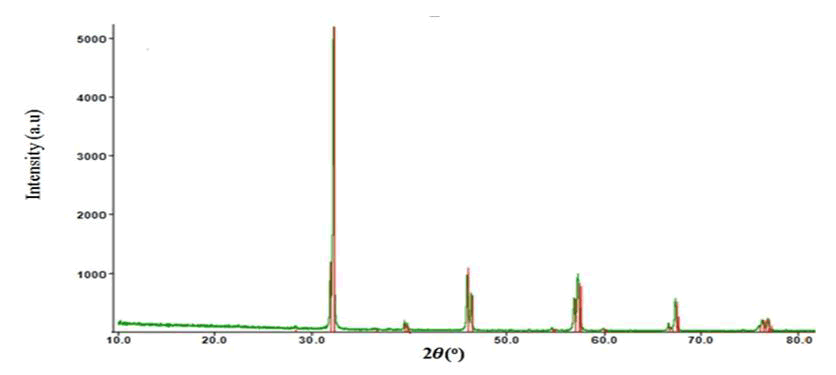
Figure 2. Comparison of room temperature theoretical (red) and experimental (green) XRD spectra recorded from AgNbO3 (AN) pure powder.
Room temperature XRD traces may be indexed for AgNbO3 according to a perovskite orthorhombic structure with Pb cm symmetry (Joint Committee on Powder Diffraction Standard, JCPDS, card 52-405), as seen in Figure 3, while XRD traces at room temperature may be indexed for LixAg1-xNbO3 (x=0.05) according to a trigonal structure with an R3c symmetry JCPDS card 53-346, as shown in Figure 3. In the first instance, the apparent change was not found in the profile of the peaks, apart from the shifting. We believe that at this stage, the change might be in the space group and crystal structure, which could not be within the detection range of the in-house XRD (Figure 4).
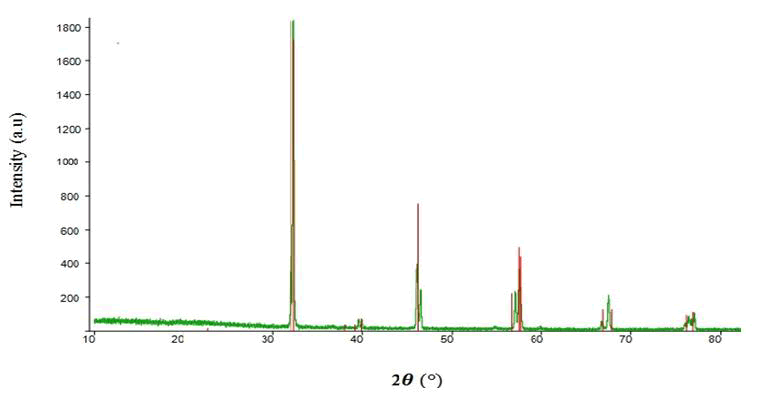
Figure 3. Comparison of room temperature theoretical (red) and experimental (green) XRD spectra recorded from (LixAg1-x) NbO3 (x=0.05) calcined powder.
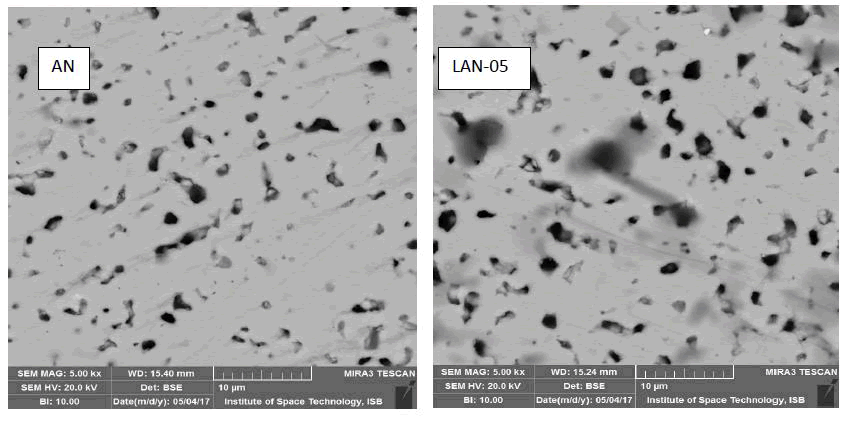
Figure 4. SEM micrograph of the polished and thermally etched surfaces of (LixAg1-x) NbO3 samples.
Microstructural analysis
To examine the SEM images obtained from the polished surfaces of ALN, the picture shows that all the ceramics have nearly a homogeneous composition and negligible influence of lithium concentration on sample porosity.
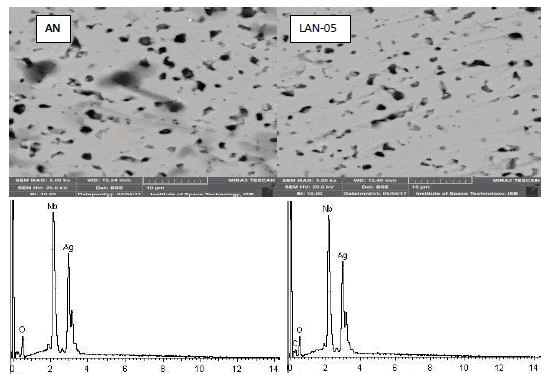
In Figure 5, the SEM images obtained from the polished surfaces of AN ceramics show that the grains are well developed and of various sizes up to 10 μm. The sizes of several grains are very small and increase with increasing x. This result is in agreement with the results of other studies.
Figure 5. Polarization vs. field curves: ferroelectric response
Note that the grains are fused into each other in all the images. Even with thermal etching of the samples, the grain size and boundaries could not be clearly determined.
Chemical analysis: EDS spectra: Energy dispersive X-ray spectroscopy was performed for all the samples; the overall scanning of the samples revealed that the spectrum compositions of the EDS peaks are similar. However, the differences are noted in the energy spectra of the intensity of Ag- peaks. The peaks of Ag recorded from the labeled regions “A” and “C” were more pronounced than those recorded from region “B”, with percent ratios of Ag at 29.58% and 28.58% sequentially from regions A and C, whereas at 16.58% from region “B”, this phenomenon supports our previous work that some metallic silver formed in the interior of the bulk due to the volatilization of Ag and Li may have come out from the pores and spread along the edges. Therefore, Li cannot be detected by the in-house EDS detectors used for analysis; thus, we did not obtain any Li-peaks from Li-doped samples.
Figures 6 and 7 shows polarizations vs. field hysteresis loops obtained at room temperature under a maximum electric field of 7.4086 kV/cm. Pure AgNbO3 shows some hysteresis but is not a classic ferroelectric material. The plot was linear, and there was no evidence of any switchable polarization. In addition, the Li concentration to AN has the tendency to increase its remnant polarization Pr and coercive field Ec at room temperature.
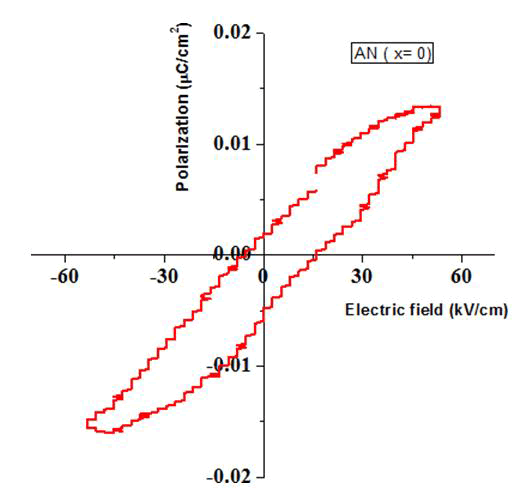
Figure 6. Ferroelectric loop of AT ceramic.
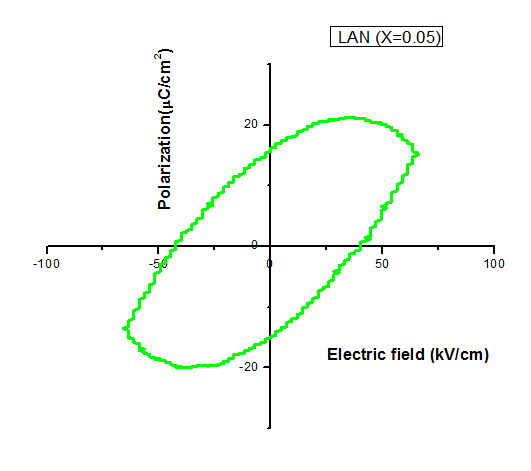
Figure 7. Room temperature ferroelectric data for LAT ceramic.
A system with Li doping as low as 0.05% can trigger ferroelectricity in AgNbO3. Figure 1 illustrates P-E ferroelectric loops for ALN ceramics at room temperature. A remnant polarization Pr of 15.958 µc/cm2, a coercive field Ec of ~40.559 kV/cm and a saturation polarization Ps of ~15.446 µc/cm2 were observed [20]. We believe that the processing parameters accompanied by a low (0.05%) Li content might be responsible for ferroelectricity.
From the above Figures 6 and 7, it is concluded that pure AN is less ferroelectric, while the addition of 0.05% Li to AN shows significant and non-switchable evidence of linear ferroelectricity.
The AgNbO3 and Nb-rich compositions are more difficult to fabricate because they require high reaction and sintering temperatures. AgNbO3 is mostly prone to silver volatilization at ~1350°C. For that reason, a lower temperature of 1200°C was used for sintering AgNbO3. Hence, AN and ALN were fabricated successfully.
No symmetry changes were observed in AgNbO3, in agreement with other authors. At room temperature, AgNbO3 exhibits a weak ferroelectric hysteresis loop at 7.4086 kV/cm. The substitution of Li (X=0.05) for Ag increases the average polarizability of the A-site ion and induces ferroelectricity. The polarization vs. electric loops undergo a step change from a slim to an unsaturated superstructure loop, which suggests a weak ferroelectricity for the orthorhombic Pbcm structure. Li-doped AN (X=0.05) is a weak ferroelectric material that is not commercially available. We believe that there is still much room for optimizing the processing parameters for pure and Li-doped AN.
This Project was supported by researcher Supporting Project number (RS2024R238) King Saud University Riyadh, Saudi Arabia.
[Crossref] [Google Scholar] [PubMed]