
Research & Reviews: Journal of Veterinary Sciences
 Menu
Menue-ISSN No.:2581-3897
e-ISSN No.:2581-3897
Amaru Amajo*
Department of Agriculture and Rural Development, Wolega, Oromia, Ethiopia
Received: 25-Jul-2024, Manuscript No. JVS-25-143195; Editor assigned: 29-Jul-2024, Pre QC No. JVS-25-143195 (PQ); Reviewed: 12-Aug-2024, QC No. JVS-25-143195; Revised: 06-Jan-2025, Manuscript No. JVS-25-143195 (R); Published: 13-Jan-2025, DOI: 10.4172/2581-3897.9.1.001
Citation: Amajo A. Review on Prevalence of Bovine Trypanosomosis in Wolayita Zone Damot Woide District of Ethiopia. RRJ Vet Sci. 2025;9:001.
Copyright: © 2025 Amajo A. This is an open-access article distributed under the terms of the Creative Commons Attribution License, which permits unrestricted use, distribution and reproduction in any medium, provided the original author and source are credited.
Visit for more related articles at Research & Reviews: Journal of Veterinary Sciences
Trypanosomosis is a disease complex because of several species of unicellular protozoan parasites of the genus Trypanosoma. The most vital trypanosomes, in terms of monetary loss in home farm animals are tsetse transmitted species: T. congolense and T. vivax. Go sectional examine become performed in Damot Woide district of Wolayita administrative quarter of southern place of Ethiopia, from November 2023 to April 2024 to estimate the superiority of bovine trypanosomiasis. Inside the parasitological survey, blood samples of one hundred twenty cattle have been tested using a buffy coat technique and skinny blood smear below Giemsa stain. The Packed cell extent (PCV) cost of every animal was also measured using hematocrit reader. The general occurrence of trypanosomiasis became observed to be 6.6%. The prevalence numerous between different have a look at regions; 4.5% in Badessa, 8.5% in Sadebo keblle, 5% in Adecha kebelle and 6.1% in Anka-shashara kebelle. The maximum nice instances had been because of Trypanosoma congolense (60%) accompanied via Trypanosoma vivax (29.6%) and blended contamination from Trypanosoma congolense and Trypanosoma vivax became additionally recorded in (17.3%) of the tasted animals. The imply PCV cost (%) of parasitaemic and aparasitaemic animals in the course of the examine length had been 22.43% and 30.14% with a statistically importance (P<0.05) difference between the two groups. The study also demonstrated variations in the prevalence among different age groups and between both sexes were statistically insignificant (P>0.05) but body condition has giant association with trypanosomiasis prevalence. As the take a look at revealed bovine trypanosomiasis of the examine place has outstanding impact on production, implementing manage of trypanosomiasis with an integrated methods have critical significance in the observe web site.
Bovine trypanosomiasis; Protozoan parasites; Damot woide
Trypanosomiasis is a disorder due to several species of protozoan parasites (Trypanosomes) observed within the blood and other tissues of vertebrates consisting of farm animals, flora and fauna and people. It's miles a first-rate obstacle to cattle farming in sub-Saharan Africa and limits the total potential of agricultural improvement inside the 36 countries wherein it's miles endemic [1]. The tsetse infested area covers 1-0.33 of the land location in jap and southern Africa. In Africa, the general loss (in each direct and oblique) is anticipated as 500 billion bucks a year in time period of mortality, abortion, reduced fertility, milk meat production and potential to paintings as traction animals [2].
In Ethiopia, tsetse infested region anticipated around 10,997 hectares from the overall of 122,190 hectares. The tsetse flies are confined to the southern, southwestern and north-western place wherein the primary vectors exist alongside the terrific rivers basin of Abay, Omo, Gibe and Baro. The fly has infested an anticipated a hundred 30,000-200,000 rectangular kilometers of fertile land in the country. In commonly, in Ethiopia 20,000 heads of farm animals die in each year and 14 million heads of bovine at chance contracting Trypanosomiasis at any time [3].
There are six pathogenic species of trypanosomes which can be located in Ethiopia, namely Trypanosoma vivax, T. congolense, T. brucei, T. evansi, T. equiperdum and T. rhodesiense. However the most critical trypanosomes inside the country are T. vivax and T. congelense. Each species affect a first-rate range of farm animals which might be the most critical species of the home animals in Ethiopia [4].
The hassle of trypanosomiasis changed into additionally suggested being very serious within the have a look at vicinity. During a survey achieved via Sodo Regional Veterinary Laboratory, farmers reported that trypanosomiasis is the maximum essential constraint to livestock improvement in the place. And trypanosomiasis was considered to be a critical disease of cattle in unique a part of the country in reviews of [5-10].
But, studies have not yet been performed on the epidemiology, prevalence and economic importance of bovine trypanosomiasis on this examine web site. consequently, the objectives of the study were to estimate the prevalence of bovine trypanosomiasis in examine vicinity, to identify the dominant species of trypanosomes and some related danger factors and to compute Packed cellular quantity (PCV) when it comes to trypanosomiasis.
Study area
Damot Woide Woreda has a complete area of 26,550 hectors and lies an elevation ranging from 1001-2500 meters above sea degree and observed on latitude of 6.68-6.96 and longitude of 37.8-38.84. Damot Woide Woreda has 23 peasants association with a total population of 125,812 (DWWANR, 2018). It was positioned approximately 406 km from Addis Ababa. Concerning the agro ecology of the woreda out of the entire land size 35% is lowland and 65% midland. The annual mean temperature 17.6-25 co and annual suggest rainfall stages 1001 mm-1400 mm. The cattle population was farm animals (165,879), sheep (85,841), goat (95,478), equine (7,943) and fowl (105,171).
Study design
Cross-sectional type of study was conducted in four randomly selected peasant associations of Damot Woide district to estimate the prevalence of bovine trypanosomiasis, to identify the prevailing species of trypanosomes and to assess the host related risk factors of a disease.
Study population
The take a look at population constitutes zebu livestock that are managed below small holder blended farming system. Animals had been allowed to graze freely in the course of the day time and housed at some point of the night time. The age of animals become grouped underneath much less than 1 yr, 1-3 years and more than 3 year of age, the body situation of the animals grouped beneath top, medium (mild) and terrible primarily based at the approach of scoring the frame circumstance of Zebu farm animals.
Sampling method and sample size determination
Two stage cluster sampling method was followed to pick out the take a look at animals. First, five peasant institutions in Damot Woide district and house holders from each decided on peasant associations are decided on with the aid of simple random sampling approach and all the livestock herds located in every house holder were selected for sample collection.during facts collection age, sex and frame situation of the animals have been recorded.
The anticipated prevalence of 6.3% from [10] document on the superiority of bovine trypanosomiasis in Kindo Koysha district of Wolayita quarter, the boarder district to Damot Woide district, were taken to calculate the sample length. The range of animals to be sampled in the observe was expected by way of the components defined.
n=1.962 x Pexp (1-Pexp)/d2
n=90
Where, n is sample size, d is absolute precession and Pexp is expected prevalence The 95% confidence interval and 5% precision was used and the calculated sampling size was 90 but 120 samples were taken to increase the precision.
Parasitological and hematological examinations techniques
Measuring of Packed Cell Volume (PCV): Blood samples were acquired through puncturing the marginal ear vein with a lancet and blood became accumulated directly into a capillary tube and crammed as much as ¾ of the tube. The capillary tubes were located in micro haematocrit centrifuge with sealed quit outer most of 1 side. The tube become loaded symmetrically to make certain precise stability. After screwing the rotary cover and closing the centrifuge lid, the specimens have been allowed to centrifuge at 12,000 rpm for 5 min. Tubes were then located in haematometer and the readings had been expressed as a percent of packed crimson cells to the entire extent of complete blood. Animals with PCV<24% had been taken into consideration to be anemic.
Buffy coat technique: To do buffy coat approach, the capillary tube became cutted from 1 mm under the layer of buffy coat to consist of the higher most layers of the pink blood cells and the content of the capillary tube changed into expressed directly to slide, homogenized directly to an easy glass slide and included with cover slip. The slide was tested below x40 goal for the presence of parasite.
Thin blood smear: A small drop of blood from a microhaematocrit capillary tube to the slide turned into applied to a clean slide and spread via the use of any other clean slide at an attitude of 45º, air dried and glued for 2 min in methyl alcohol, then immersed in Giemsa stain (1:10 solution) for 30 minute. The extra stain became tired and washed by means of the usage of distilled water, allowed to dry by using status up proper on the rack and tested underneath the microscope with oil immersion goal lens.
Data management and analysis: Raw statistics of man or woman animals and exam outcomes were stored in Microsoft Excel spread sheets to create facts base and transferred to SPSS model 20 software program applications for facts analysis. Chi square was used to examine the prevalence of trypanoa few infection with exclusive risk elements variables like peasant association, age, intercourse and body circumstance, while t-test was applied to examine the mean PCV of the inflamed animals and non-infected animals. Importance difference became set at p<0.05 and 95% confidence level.
Parasitological results
Out of the overall one hundred twenty livestock tested, 8 (6.6%) had been observed high-quality to trypanosomiasis. the prevalence of trypanosomiasis in decided on peasant institutions is 4.5% in Badesa, 8.5% in Sadebo, 5% in Adecha and 6.1% in Anka-shashara areas. however the association between peasant institutions and the superiority of trypanosomiasis isn't statistically extensive (p>0.005).
The maximum prevalent trypanosome species in the look at place changed into T. congolense (60%) accompanied via T. vivax (29.6%) and mixed infection from T. vivax and T. congolense changed into also recorded in (17.3%) of the tasted animals. the superiority of trypanosome infection was better in girl (6.6%) than male (5.1%) animals; but, there was no statistically widespread (p>0.05) fluctuate-ences observed among the two sexes. A higher contamination price of 9.0% turned into found in adult animals (animals above one year and under three years of age) and accompanied by using 6.0% in antique animals (above 3 years) and 0% in younger animals with within the study area but the version became not statistically massive (p>0.05).
Cattle infected with trypanosome have bad body condition rating than the non-inflamed animal. There was a statistically significant (p<0.05) difference among the prevalence of trypanosomes in different frame conditions (Table 1).
| Risk factor | Animal sample | No of animals infected | Over all infection | X2 value | p-value | ||
| T. congllence | T. vivax | Both | |||||
| Peasants add | |||||||
| Badesa | 27 | 1 | 0 | 0 | 1 (5.0%) | 0.346 | 0.951 |
| Sadebo | 29 | 1 | 1 | 0 | 2 (8.3%) | - | - |
| Adecha | 41 | 2 | 0 | 1 | 2 (5.1%) | - | - |
| Anka-shashara | 23 | 1 | 1 | 0 | 2 (5.1%) | - | - |
| Sex | |||||||
| Female | 49 | 3 | 1 | 0 | 4 (6.6%) | 0.118 | 0.731 |
| Male | 71 | 2 | 1 | 1 | 3 (5.1%) | - | - |
| Age | |||||||
| Young (<1 year) | 40 | 0 | 0 | 0 | 0 (0.0%) | 3.253 | 0.198 |
| Adult (1-3 year) | 42 | 4 | 1 | 1 | 5 (9.6%) | - | - |
| Old (>3 year) | 38 | 1 | 1 | 0 | 2 (5.3%) | 9.717 | 0.008 |
| Body condition | |||||||
| Poor | 30 | 2 | 2 | 1 | 5 (17.2%) | - | - |
| Medium | 56 | 2 | 0 | 0 | 2 (4.0%) | - | - |
| Good | 34 | 0 | 0 | 0 | 0 (0.0%) | - | - |
Table 1. Association of risk factors with prevalence of trypanosomiasis.
Hematological results
The PCV price ranging from 18 to 34 became found from the observed animals. Out of the determined animals, infected animals had a median PCV cost of 19.43% and non-inflamed animals had 27.14% and the general imply PCV cost of the observe also ended in 26.69%. Statistically good sized distinction (P<0.05) in suggest PCV turned into located between infected and non-inflamed animals (Figure 1).
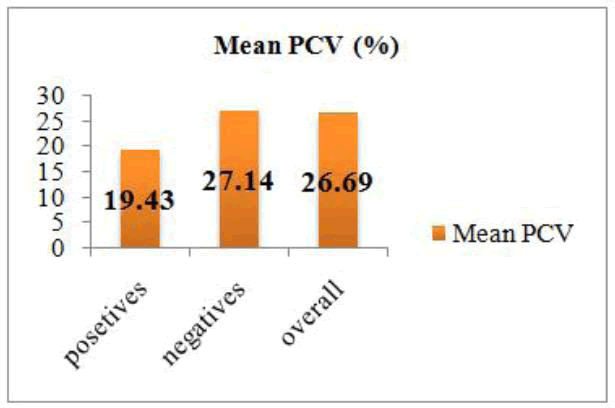
Figure 1. Mean PCV value comparison of infected and non-infected animals.
The have a look at discovered that the prevalence of bovine trypanosmosis within the region turned into 6.6% (8/120) which become in notably settlement with the previous findings by Habtewold at Humbo arena of Wolaita quarter (9.3%) Shimelis et al. and Bitew et al (11.7%) however a whole lot lower than the report of Terzu, Mesfin and Getachaw and Amare who discovered 15, 15.8, 37, 35.5 and 21% incidence of bovine trypanosomosis respectively at Omo river basin of south western Ethiopia.
The findings of the contamination price with T. congolense inside the present study which is 60% is within the line with the record of [10] at Kindo Koysha district of Wolayita (58%), [3] report shape tsetse infested areas of Ethiopia (58.5%), in decided on web sites of southern region (63.4%) and [9] in West Gojam (54.3%). The extended seasoned portion of infection with T. congolense within the have a look at area can be because of the major cyclical vectors of the savannah setse flies, (G. moristans and G. palidpes) which might be powerful in transmitting T. congolense than T. vivax for the reason that look at vicinity is located inside the tsetse belt of Ethiopia.
Contamination price in poor body conditioned animals were significantly better than desirable body condition animals (p<0.05) and was in agreement with [9]. Although higher infection rate was observed in animals of between 1 up to 3 years of age (9.6%) and animals above three years of age (5.3%), in the present study no statistically significant (p>0.05) affiliation turned into observed in age. This end result is in settlement with the previous results stated by means of [7,9]. This may be due to the truth that every one animals graze and used as draft as well as harvesting of vegetation to the equal tsetse challenged regions. Younger animals of beneath 1 years of age are included from the disorder and 0% prevalence turned into located. That is may be because of suckling calves do now not go out with their dams however graze at homesteads till they may be weaned off. Younger animals also are naturally protected to some extent through maternal antibodies. This will bring about low prevalence of trypanosome in calves. The prevalence level also specific in exceptional areas however the affiliation isn't always sizeable. Similarly, intercourse has insignificant association (P>0.05) with infection price because it became also mentioned by [9].
The mean PCV fee of studied animals turned into drastically (P<0.05) varying among parasitaemic (19.43%) and aparasitaemic (27.14%) animals. This result changed into in agreement with the previous consequences said via [1]. Even though significant difference is determined within the look at, PCV by myself couldn't be used for diagnostic criteria for trypanosomiasis due to the fact there also are other factors causing anemia along with trojan horse infestation and dietary deficiency.
From this have a look at, it is possible to finish that trypanosomiasis is an important ailment and an ability hazard affecting the fitness and productivity of livestock inside the observe area. The predominant species of trypanosomes within the observe vicinity have been T. congolense accompanied by way of T. vivax and blended infection of the two species. Contamination with trypanosomiasis negatively affected PCV and body condition. This indicated that trypanosome contamination of farm animals reason’s loss of body weight and manufacturing.
Based on the finding the following recommendations are forwarded:
[Crossref] [Google Scholar] [PubMed]
[Google Scholar] [PubMed]
[Crossref]
[Crossref] [Google Scholar] [PubMed]