
Research & Reviews: Journal of Ecology and Environmental Sciences
 Menu
MenuISSN: 2347-7830
ISSN: 2347-7830

 +44-7723-59-8358
 Yumi Suzuki*, Kaneyuki Nakamura
Department of Environmental Sciences, Aichi Prefectural Meiwa Senior High School, Nagoya, Japan
Received: 18-Jul-2024, Manuscript No. JEAES-24-142197; Editor assigned: 22-Jul-2024, Pre QC No. JEAES-24-142197 (PQ); Reviewed: 05-Aug-2024, QC No. JEAES-24-142197; Revised: 15-Dec-2025, Manuscript No. JEAES-24-142197 (R); Published: 03-Jan-2025, DOI: 10.4172/2347-7830.13.1.001
Citation: Suzuki Y, et al. Wildlife Survey Report of Meiwa Senior High School. RRJ Ecol Environ Sci. 2025;14:001.
Copyright: © 2025 Suzuki Y, et al. This is an open-access article distributed under the terms of the Creative Commons Attribution License, which permits unrestricted use, distribution and reproduction in any medium, provided the original author and source are credited.
Visit for more related articles at Research & Reviews: Journal of Ecology and Environmental Sciences
Aichi Prefectural Meiwa High School is situated in the heart of Nagoya city, surrounded by significant historical sites such as the moat of Nagoya Castle and expansive green spaces like Meijo Park. Since April 2021, the Biology Division of the SSH Club at Meiwa has conducted observational surveys of the raccoon dog (Nyctereutes procyonoides) inhabiting the moat of Nagoya Castle as part of local ecological studies. Furthermore, they have disseminated their findings through research presentations and outreach lectures, aiming to enhance public awareness of biodiversity.
Nyctereutes procyonoides; Wildlife; MEXT; COVID-19; Raccoon dog’s
Nowadays, Since 2011, Aichi Prefectural Meiwa High School has been designated by the Ministry of Education, Culture, Sports, Science, and Technology (MEXT) as a Super Science High School (SSH), focusing on fostering talents in science and technology. Among its activities, the SSH Club engages in research in the field of natural sciences. Initially, the club focused on indoor experiment suchi as microscopic examination of microorganisms and exraction of plant pigments, but due to the COVID-19 pandemic in 2020, activities were moved outdoors. Located amidst the urban landscape of Nagoya, Meiwa High School's surroundings seemed unlikely to harbor rich natural environments akin to Satoyama; however, through their surveys, they discovered unique urban ecosystems, particularly in the moat of Nagoya Castle where remnants of secondary forests thrive. This discovery prompted an investigation into the raccoon dog's activities.
Fecal analysis
From April 2021 to July 2023, approximately 100 grams of feces were collected monthly from raccoon dog latrines within the secondary forests of Nagoya Castle's moat. The collected samples were frozen and subsequently analyzed by washing and sorting through a 0.65 mm mesh sieve. The remains were categorized into plant fragments (seeds, leaves, bark, etc.), insect parts, artificial materials, and others. The findings revealed seeds in May and June and insect parts in July. Plastic debris likely originated from litter in Nagoya Castle's moat. Attempts to identify raccoon dog foraging locations involved surveys in neighboring commercial districts and Meijo Park but yielded no evidence of damage caused by raccoon dogs scavenging garbage. Nevertheless, stomach contents from raccoon dogs killed in traffic accidents around Nagoya Castle included evidence of fish fry, suggesting they forage beyond the moat's secondary forests, warranting further investigation.
Camera trap imaging
Between July 2021 and June 2022, a camera trap (Farm Age Co., Ltd. WAM CAPTURE02) was installed to monitor raccoon dog latrine sites. Monthly data retrieval and analysis recorded the times and numbers of raccoon dog sightings. Monthly averages depicted notable activity peaks in July 2021, correlating with heightened juvenile raccoon dog activity during spring and early summer. Conversely, reduced sightings from April to June 2022 were attributed to the withdrawal of parental individuals during birthing periods. Diurnal activity was infrequent, consistent with raccoon dogs' nocturnal behavior, with increased sightings at sunrise and sunset. Over the study period, family groups comprising juveniles were frequently captured, indicating consistent reproduction across three consecutive years.
In this study, besides raccoon dogs, other mammals were also captured on camera traps, including Japanese badgers, weasels, raccoons, red foxes, and domestic cats. Particularly, Japanese badgers were observed frequently after raccoon dogs, often seen consuming fruits such as loquats on the school grounds. Additionally, in 2023, a Japanese marten was recorded. Through the raccoon dog investigation, it has been confirmed that at least six species of mammals inhabit the vicinity of the high school. The frequency of other mammals appearing in camera footage is approximately once a month, suggesting their populations are not large. Starting from December 2022, the number of sensor cameras has been increased to seven, enabling further tracking surveys on the ranging behavior of raccoon dogs and other mammals.
Outreach activities
The research outcomes were presented at regional SSH school symposia, eliciting significant interest. In October 2022, Meiwa High School participated in the "Nagoya Biodiversity Center Festival," showcasing their activities to a youth audience. Furthermore, in June 2023, they conducted outreach classes for sixth-grade students at Shimizu Elementary School, focusing on local fauna and introducing preserved specimens borrowed from the Nagoya Biodiversity Center. Participants expressed surprise at discovering raccoon dogs in their vicinity, fostering community engagement and support for future research endeavors.
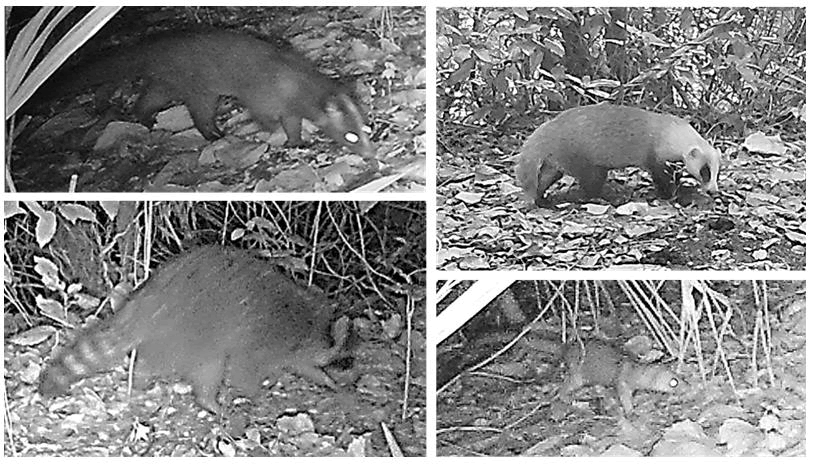
Figure 1. Mammals other than raccoons captured on camera traps: (Top left) Badger (August 15, 2022) (Top right) Raccoon dog (September 24, 2023) (Bottom left) Raccoon (November 2, 2022) (Bottom right) Weasel (October 20, 2022).