
Research & Reviews: Journal of Pure and Applied Physics
 Menu
MenuISSN: 2320-2459
ISSN: 2320-2459
Xiang Wu1* Yijie Li2, Linfei Liu2
1 Department of Engineering, Sanda University, Shanghai, China
2 Department of Physics and Astronomy, Shanghai Jiao Tong University, Shanghai, China
Received: 26-Dec-2024, Manuscript No. JPAP-24-156485; Editor assigned: 31-Dec-2024, Pre QC No. JPAP-24-156485 (PQ); Reviewed: 14-Jan-2025, QC No. JPAP-24-156485; Revised: 10-Mar-2026, Manuscript No. JPAP-24-156485 (R); Published: 17-Mar-2026, DOI: 10.4172/2320-2459.14.1.001
Citation: Wu X, et al. Mini-Review: Investigating the Influence of Target Density on the Properties of YGBCO Superconducting Thin Films. RRJ Pure Appl Phys. 2026;14:001.
Copyright: © 2026 Wu X, et al. This is an open-access article distributed under the terms of the Creative Commons Attribution License, which permits unrestricted use, distribution and reproduction in any medium, provided the original author and source are credited.
Visit for more related articles at Research & Reviews: Journal of Pure and Applied Physics
Superconducting materials, particularly High-Temperature Superconductors (HTS), have been the subject of intense research due to their promising applications in various fields such as power transmission, scientific instrumentation, and transportation. Among these materials, YttriumGadolinium-Barium-Copper-Oxide (YGBCO) films stand out for their excellent superconducting properties, making them ideal for the development of nextgeneration High-Temperature Superconducting (HTS) tapes. A critical factor influencing the quality of these films is the density of the target material used in their preparation. The study conducted by us systematically investigates how variations in the density of YGBCO targets affect the properties of the resulting superconducting thin films. This review will discuss the findings, the importance of target density in thin film growth, and its implications for the production of YGBCO films and tapes.
YGBCO films; Pulsed laser deposition; Surface quality; target density
The role of target density in YGBCO film growth
The preparation of YGBCO superconducting thin films by Pulsed Laser Deposition (PLD) involves using target materials of varying densities. The density of the YGBCO target plays a significant role in determining the crystallinity, surface morphology, and superconducting properties of the resulting films. Our study explores how different target densities from 4.0 g/cm³ to 5.5 g/cm³ affect various parameters of YGBCO films, such as their microstructure, texture, surface roughness, and superconducting performance [1].
One of the most significant findings of this study is the direct relationship between target density and the crystallinity of the YGBCO films. As shown in Figure 1, films produced using the lowest target density (4.0 g/cm³) demonstrated the highest crystallinity. This is supported by X-ray Diffraction (XRD) patterns, which reveal a pronounced c-axis orientation with minimal broadening of the diffraction peaks. As the target density increased, the films displayed reduced crystallinity, with a marked decrease in the intensity of the diffraction peaks. This reduction in crystallinity can be attributed to the increase in lattice distortion, which becomes more pronounced at higher target densities. The research suggests that for optimal crystalline quality, low-density targets are preferable [2].
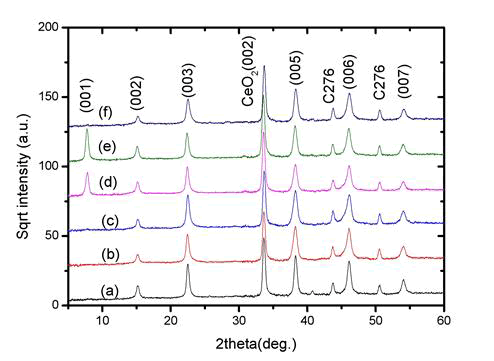
Figure 1. XRD θ-2θ scans of YGBCO films deposited by PLD using different target: (a) D1, 4.0 g/cm3, (b) D2, 4.3 g/cm3, (c) D3, 4.6 g/cm3, (d) D4, 4.9 g/cm3, (e) D5, 5.2 g/cm3, (f) D6, 5.5 g/cm3.
Microstructural influence: Growth mechanisms and surface morphology
The microstructure and surface morphology of YGBCO thin films are crucial for their superconducting properties, as they determine the film's ability to carry current without resistance. Our study reveals that the surface morphology is significantly affected by the density of the target material. As shown in Figures 2 and 3, Scanning Electron Microscopy (SEM) and Atomic Force Microscopy (AFM) results show that films grown from low-density targets (4.0 g/cm³) have smooth, dense surfaces with minimal surface roughness (5.5 nm). In contrast, films grown from high-density targets exhibit increased surface roughness, with the roughness reaching 8.3 nm for the highest-density target (5.5 g/cm³) [3].
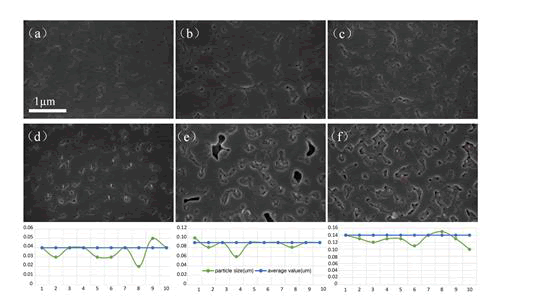
Figure 2. SEM images of YGBCO films deposited using different density targets: (a) D1, 4.0 g/cm3, (b) D2, 4.3 g/cm3, (c)D3, 4.6 g/cm3, (d)D4, 4.9 g/cm3, (e) D5, 5.2 g/cm3, (f) D6, 5.5 g/cm3.
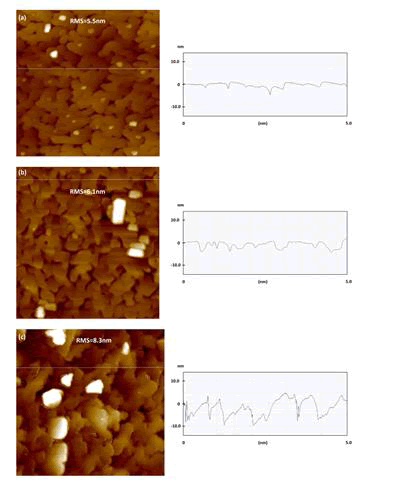
Figure 3. AFM images of YGBCO films deposited using different density targets: (a) 4.0 g/cm3, (b) 4.3 g/cm3, (c) 5.5 g/cm3.
The increased roughness in films from high-density targets can be explained by the different growth mechanisms that occur depending on the density of the target. High-density targets tend to favor an island-like growth mode, resulting in a surface with larger particles and pores. Conversely, low-density targets support layered growth, where atoms are deposited in a more uniform, two-dimensional manner. This leads to smoother surfaces and better current-carrying capabilities, as the uniformity of the thin film helps reduce scattering centers that impede superconducting currents. This finding has significant implications for the design of films intended for applications requiring high current densities, such as in the manufacturing of superconducting cables [4].
Superconducting properties: The impact of target density on performance
The superconducting performance of YGBCO films is closely tied to their microstructural characteristics. Our study investigates the critical current (Ic) and critical current density (Jc) of the YGBCO films prepared with different target densities, as shown in Figure 4. Critical current density is a vital parameter for superconductors, as it indicates the maximum current that can flow through the material without generating resistive losses. The study finds that films prepared with low-density targets exhibit the highest critical currents and current densities. Specifically, the YGBCO films fabricated from the 4.0 g/cm³ target displayed a critical current of 135 A and a current density of 5.4 × 10⁶ A/cm². On the other hand, films grown from high-density targets had lower critical currents and current densities, with values dropping to 60 A and 2.4 × 10⁶ A/cm² at the highest target density (5.5 g/cm³) [5].
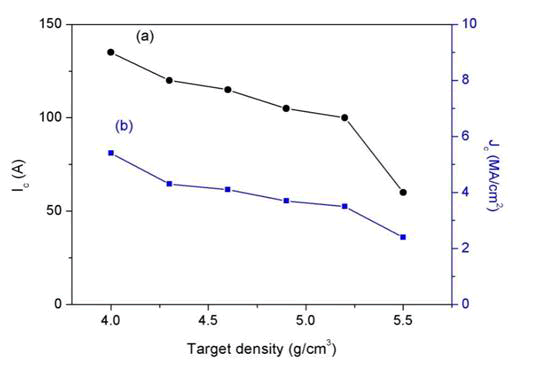
Figure 4. Ic (a) and Jc (b) of YGBCO films as a function of target density.
This decrease in superconducting performance with increasing target density can be attributed to the changes in microstructure and surface morphology discussed earlier. The rougher surface and increased lattice distortion in films from high-density targets create more obstacles for superconducting currents, limiting their ability to carry higher currents. Moreover, the presence of pores and particles on the surface further disrupts current flow, reducing the overall superconducting performance [6].
Long-tape production and industrial implications
Beyond the fundamental analysis of thin films, our study also explores the preparation of second-generation HTS long tapes using optimized YGBCO target densities. These long tapes are crucial for the industrialization of HTS materials, as they can be used in power cables, magnets, and other large-scale applications. Our research demonstrates that by optimizing the target density, high-quality YGBCO films can be applied to a 530-meter-long superconducting tape. The resulting tape achieved a critical current of 380 A and a current density of 4.2 × 10⁶ A/cm², as shown in Figure 5, making it competitive with the world’s leading superconducting tape technologies [7,8].
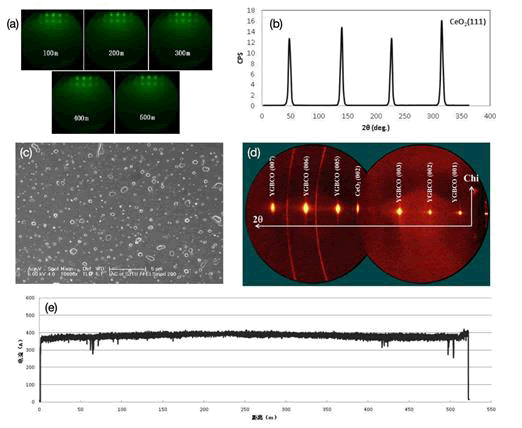
Figure 5. (a) RHEED image of IBAD-MgO tape for each 150 m, (b) ä-scan map of CeO2 long tape, (c) XRD image of HGBCO long tape, (d) SEM image of HGBCO long tape, (e) Longitudinal Ic profile of a 530 m long REBCO tape measured by Tapestar.
This achievement represents a significant step towards the commercialization of HTS long tapes. It also highlights the importance of process optimization, not just for achieving high superconducting performance but also for scalability in industrial applications. By fine-tuning target density and other deposition parameters, the performance and cost-effectiveness of HTS tapes can be improved, accelerating the adoption of superconducting materials in various fields [9].
In summary, the study provides a comprehensive analysis of how the density of YGBCO targets influences the properties of superconducting thin films. The findings underscore the critical role that target density plays in determining the crystallinity, surface morphology, and superconducting performance of YGBCO films. Low-density targets result in films with better crystallinity, smoother surfaces, and higher critical currents, making them ideal for applications requiring high current densities. The study also demonstrates the successful application of these optimized films in the production of long HTS tapes, furthering the potential for their industrial use. As such, this research provides valuable insights into the manufacturing of high-performance superconducting films and tapes, offering a pathway towards the commercialization of next-generation superconducting technologies.
[Crossref] [Google Scholar] [PubMed]