
Research & Reviews: Journal of Pure and Applied Physics
 Menu
MenuISSN: 2320-2459
ISSN: 2320-2459
Jeha Kim*
Department of Energy Convergence Engineering, Cheongju University, Eumseoung-gun, Chungbuk 27739, Republic of Korea
Received: 14-Oct-2024, Manuscript No. JPAP-24-150078; Editor assigned: 16-Oct-2024, Pre QC No. JPAP-24-150078 (PQ); Reviewed: 30-Oct-2024, QC No. JPAP-24-150078; Revised: 05-Mar-2025, Manuscript No. JPAP-24-150078 (R); Published: 12-Mar-2025, DOI: 10.4172/2320-2459.13.1.007
Citation: Kim J, Parametric Study for α CsPbI2Br Film Growth by Mist Chemical Vapor Deposition. RRJ Pure Appl Phys. 2025;13:007.
Copyright:© 2025 Kim J. This is an open-access article distributed under the terms of the Creative Commons Attribution License, which permits unrestricted use, distribution and reproduction in any medium, provided the original author and source are credited.
Visit for more related articles at Research & Reviews: Journal of Pure and Applied Physics
Using an atmospheric mist Chemical Vapor Deposition (CVD), we fabricated successfully CsPbI2Br films under various growth conditions: CsPbI2Br precursor of 0.4 molar concentration, carrier and dilution N2 flow rates of 200 and 1500 cc/min, substrate temperature of 68°C, and growth time of 35 min.
Atmospheric mist chemical vapor deposition; Perovskite crystalline growth; Molar concentration ratio; Growth temperature; N2 gas flow rate
Currently, perovskite solar cells have garnered considerable attention because of their high efficiency of up to 25.2% [1], low cost, and simple process, which allow their commercial applications [2-5]. Perovskites are composed of organic volatile molecules that induce to form hydro-compounds with the moisture in air [6-8]. To reduce such degradation in air, inorganic cation Cs+ is used to form purely inorganic CsPbX3 (X=I, Br) for stability [9-11]. Under a humid environment, α-CsPbI2Br has relatively stable bandgap energy of 1.92 eV and transforms the dark phase with low bandgap to the yellow phase with high bandgap energy of 2.85 eV [12]. Among various methods [13-19], pseudo-CVD is known as a new approach proposed for perovskite film preparation that uses microscopic mists of a solution, referred to as mist CVD.
As for preparing high quality cubic α-CsPbI2Br films by mist CVD, in this report, we investigated systematically the film preparation with various parameters and optimized them.
Sample preparation
Figure 1 is a schematic of mist CVD with the reactor channel heated at the bottom. The aerosol mist generated ultrasonically is directed to the reactor by N2 gas (99.8%). CsPbI2Br precursor solution was prepared using Cesium Bromide (CsBr, 99.999%) and lead (II) iodide (PbI2, 99.999%) at different molar concentrations in a mixed solvent with 4:1 (v/v%) N, N-dimethylformamide (DMF, 99.8%) and Dimethyl Sulfoxide (DMSO, ≥ 99.9%). Then CsPbI2Br precursor was stirred for 7 h at 70°C inside a N2 glove box. An ultrasonically generated microscopic mist droplet is then transferred into the reactor using N2 gas and flows through a rectangular channel of 3 mm × 108 mm × 180 mm. Inside the reactor, the perovskite grain nucleates while heating and crystallizes followed by post-annealing [20]. Table 1 shows a summary of the experimental parameters for the growth study. The details will be found in the previous report [21].
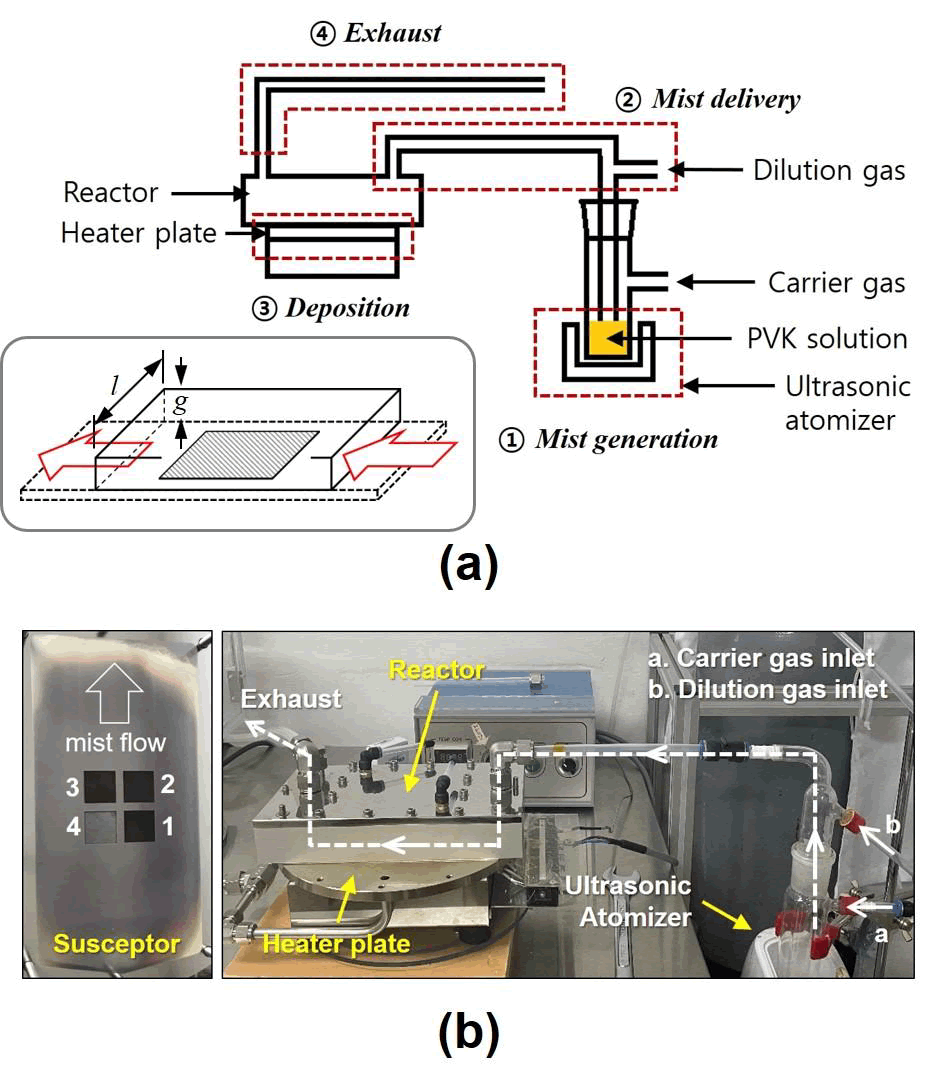
Figure 1. (a) Schematic of the mist CVD process and (b) Photo of instrument.
| Parameters (unit) | Values |
| Concentration of precursor (Mole) | 0.2/0.4/0.6 |
| Growth temperature, Tsub (°C) | 72/68/60 |
| Growth time, tG (min) | 35/35/30 |
| Flow rate of carrier, Qc (cc/min) | 150/200/225 |
| Flow rate of dilution, Qd (cc/min) | 1300/1500/1700 |
Table 1. Combination of parameters of the CsPbI2Br film growth.
Results and Discussion
As shown in Figure 2 (a-c), the FE-SEM images of the films with precursors of 0.2, 0.4, and 0.6 M exhibit a smooth surface with an exception of 0.2 M sample having voids and nodules on the film. Figure 2 (d) shows the X-ray diffraction spectrum for the samples of 0.4 M produced the reflections at 14.68°, 20.94°, and 29.68° corresponding to the cubic α-CsPbI2Br (100), (110), and (200) planes, respectively [22,23].
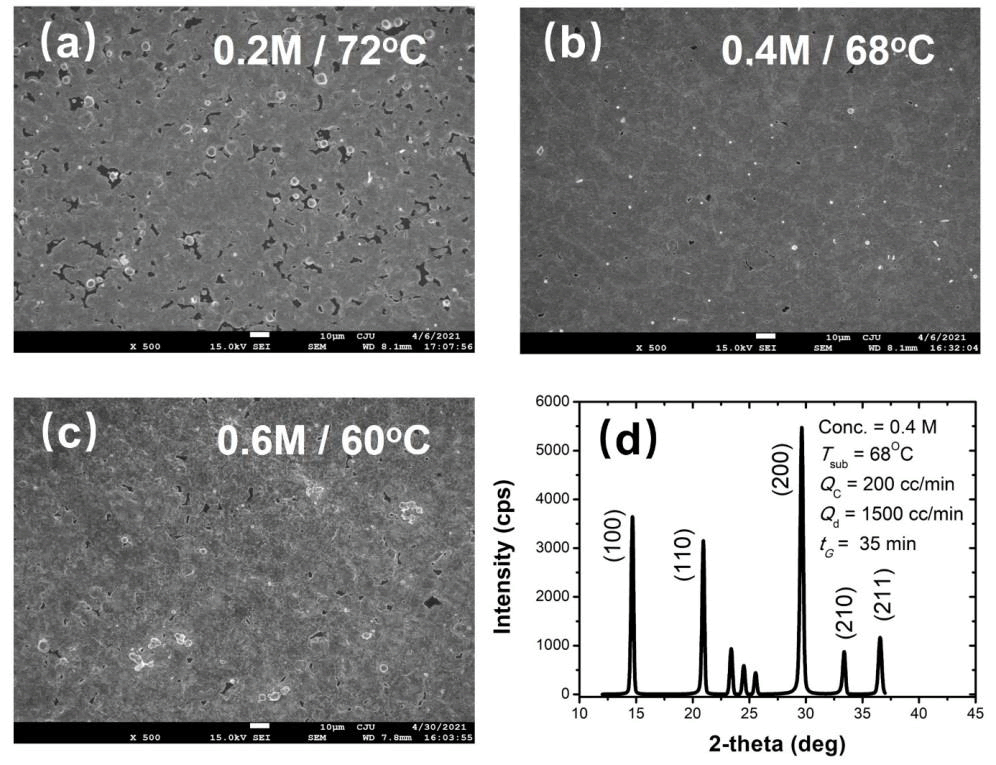
Figure 2. FE-SEM images of the CsPbI2Br with Qc=150 cc/min and Qd=1500 cc/min: (a) 0.2 M, Tsub=72°C, tG=35 min; (b) 0.4 M, Tsub=68°C, tG=35 min, (c) 0.6 M, Tsub=60°C, tG=30 min, (d) XRD spectrum for 0.2 M sample.
Figure 3 shows that the optical transmittance exhibits little variation for the wavelength λ=350-650 nm and increased rapidly at >650 nm. The optical bandgap energy Eg estimated from the Tauc plot [24] was 1.914 eV (λg of ~648 nm) (inset) that agrees with the bulk value of the α-CsPbI2Br crystal.
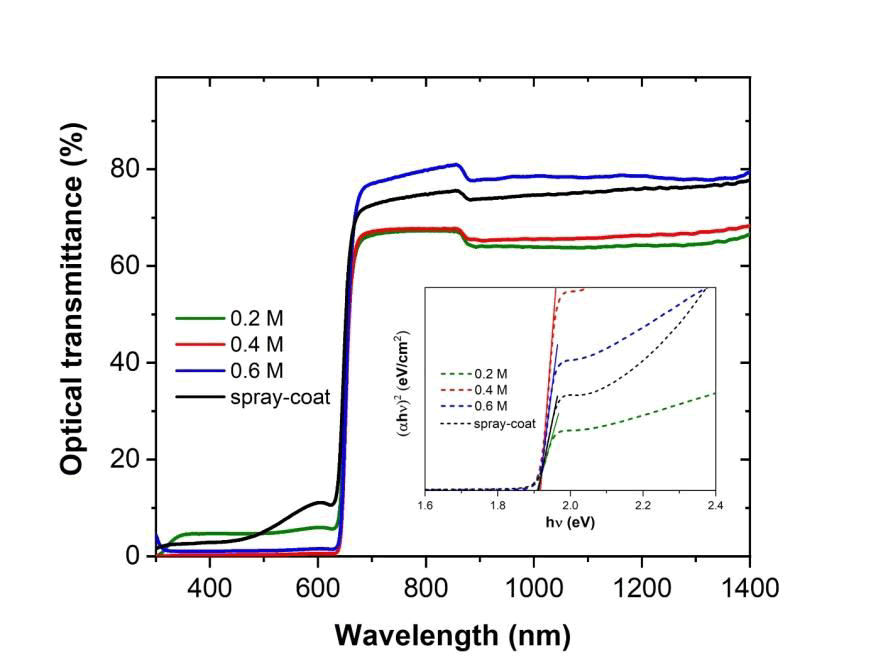
Figure 3. Optical transmittance spectra with an inset of their Tauc plots.
The amount of mist generation and transfer was dependent on the flow rates Q’s of N2 gas. A ratio of the carrier Qc to dilution Qd gas flow rates R appears an important factor for the film growth: R ~1/10. For a successful film growth with smooth and defect-free surface, Qc should be set over a threshold of 200 cc/min as shown in Figure 4 (a) and (b). As Qd increases, the individual voids generated increase slightly; Qd ≅ 1500 cc/min.
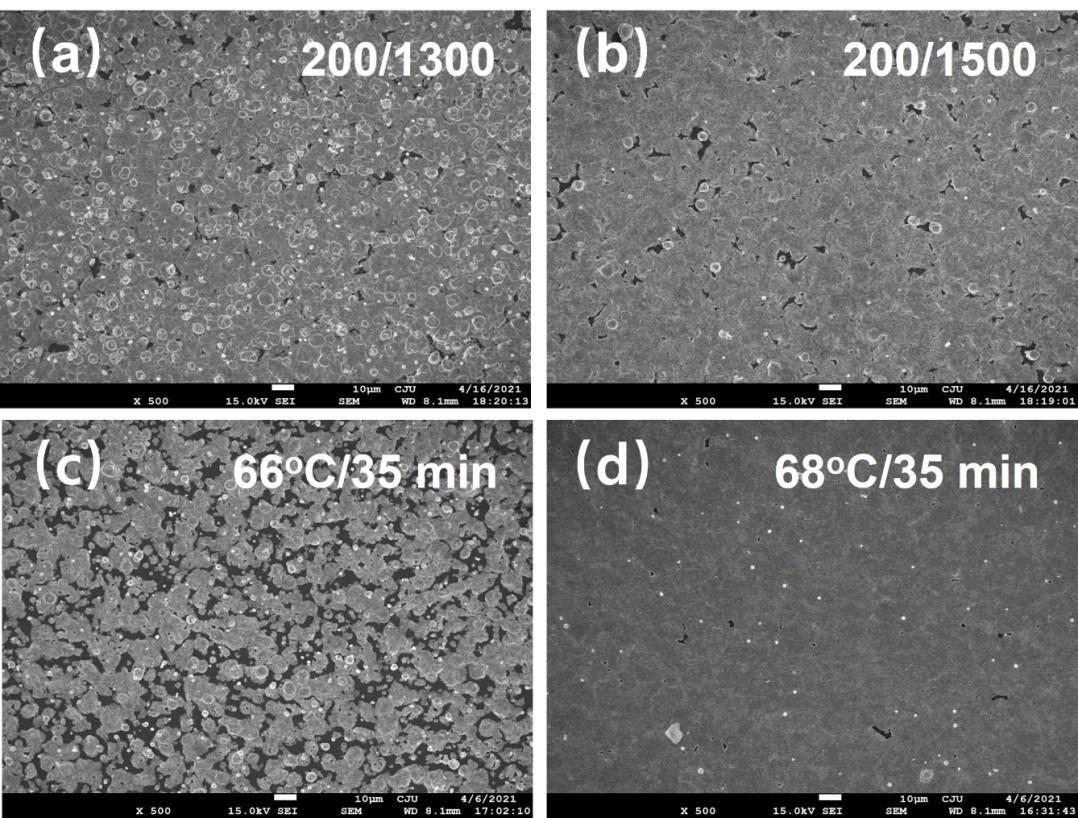
Figure 4. FE-SEM images of the samples with 0.4 M, Tsub=68°C, tG=35 min, N2 gas (Qc, Qd): (a) 200 cc/min, 1300 cc/min; (b) 200 cc/min, 1500 cc/min and the samples with Qc=200 cc/min, and Qd=1500 cc/min and different Tsub; (c) 66°C, (d) 68°C.
It was found that the surface morphology of the film is significantly affected by the substrate temperature Tsub. The surface coverage of the grains is improved dramatically as Tsub increased only by 2°C from Tsub=66°C to 68°C as exhibited in Figure 4 (c) and (d). At a higher Tsub, the film cannot be formed because the mist of the solution is dried and evacuated. At Tsub=68°C, the perovskite film exhibits the best quality with complete grains covered with smooth surfaces, minimal defect density of voids, and the lowest optical transmittance.
In addition, the growth exhibits drastic changes in the surface morphology with the growth time tG. As tG increases from 25 min to 30 min, the grains suddenly covered the entire surface and the voids disappeared in the surface, while the overall film thickness remained the same as for tG=25 min; t=1.82~2.38 μm.
For the perovskite film growth by mist CVD, it was crucial to stabilize the growth parameters while growing the perovskite films on the heated substrate. This observation implies that the film growth with time is strongly influenced by the nucleation of the crystal from the liquidous phase to a solid in the mist CVD process under the reactor environment.
In summary, using the mist CVD method we successfully prepared the growth of inorganic perovskite films verified with variety of characterization. All the samples exhibit well-defined α-CsPbI2Br crystal with Eg=1.914 eV. It was crucial to maintain the growth conditions at a narrow operation tolerance such that the amount of precursor mist was stabilized inside the reactor with the gas ratio R~1/10 at the temperature tG=68°C.
This research was financially supported by the Ministry of Trade, Industry and Energy, Korea, under the “Regional Innovation Cluster Development Program s(R and D) (P0025862)” supervised by the Korea Institute for Advancement of Technology (KIAT). This work was supported by a Chungcheongbuk-do and Chungbuk Technopark, A Study on the Accelerator Device Leading Technology Development in 2023 (SR230105).
[Crossref] [Google Scholar] [PubMed]
[Crossref] [Google Scholar] [PubMed]
[Crossref] [Google Scholar] [PubMed]
[Crossref] [Google Scholar] [PubMed]
[Crossref] [Google Scholar] [PubMed]
[Crossref] [Google Scholar] [PubMed]
[Crossref] [Google Scholar] [PubMed]
[Crossref] [Google Scholar] [PubMed]
[Crossref] [Google Scholar] [PubMed]
[Crossref]
[Crossref] [Google Scholar] [PubMed]