
Research & Reviews: Journal of Pure and Applied Physics
 Menu
MenuISSN: 2320-2459
ISSN: 2320-2459
Yuryev VA
Department of Solid State Electronics, Voronezh State Technical University, Voronezh, Russia
*Corresponding Author:
Received: 08-Oct-2024, Manuscript No. JPAP-24-149838; Editor assigned: 10-Oct-2024, Pre QC No. JPAP-24-149838 (PQ); Reviewed: 24-Oct-2024, QC No. JPAP-24-149838; Revised: 04-Mar-2025, Manuscript No. JPAP-24-149838 (R); Published: 11-Mar-2025, DOI: 10.4172/2320-2459.13.1.006
Citation: Yuryev VA. The Influence of the Entropy of Material Substances on the Local Gravitational Field Strength. RRJ Pure Appl Phys. 2025;13:006.
Copyright: © 2025 Yuryev VA. This is an open-access article distributed under the terms of the Creative Commons Attribution License, which permits unrestricted use, distribution and reproduction in any medium, provided the original author and source are credited.
Visit for more related articles at Research & Reviews: Journal of Pure and Applied Physics
Experiments with solid and liquid substances have shown that a decrease in entropy during the ordering of condensed media is accompanied by an increase in their weight. The paper provides evidence that a change in the entropy of a material system represents work on a local change in the intensity of the gravitational field.
Entropy; Gravity; Gravitational field strength; Structure of matter
In 1865, Rudolf Clausius introduced the concept of entropy as a measure of irreversible dissipation or uselessness of energy. In 1877, Ludwig Boltzmann established a correlation between entropy and the probability of a particular state of a system. Thus, entropy is associated not only with the energy of a system, but also with information about it. Entropy is an inherent property of material substances, but it cannot be measured using instruments. What it dissipated into, what work it did remains uncertain.
The work presented to your attention contains research that provides an answer to this question. The reason for the presented research was the work of astrophysicist N. A. Kozyrev [1]. Kozyrev experimentally established that immediately after impact plastic deformation, lead samples weighing 200 g decrease their weight by 10 mg (by 5–7%). After 10 minutes, their weight is practically restored.
The final restoration of weight occurs after ten hours. In non-relativistic mechanics, the weight of a material body is defined as the reaction of the support to the force of gravity (F), equal to the product of mass (m) by the strength of the gravitational field (g).
F=mg (1)
Invariant or inert mass in this case is determined only by the amount of substance. Consequently, a change in the weight of a deformed body with a constant mass (m) is possible only if the Gravitational field strength (g) changes.
If we assume a relativistic approach to discussing the results of Kozyrev’s experiment, then even at a speed of 100 km/h the relativistic change in mass is 10-13%, moreover, increasing.
Kozyrev proposed to reduce the weight of plastically deformed bodies “... to look for processes in them with a large increase in entropy.”
Savchenko’s later works [2] talk about changes in weight under the influence of both plastic and elastic deformation. Savchenko explained the change in weight by a change in the internal energy and entropy of the system.
Both Kozyrev and Savchenko connected the change in weight with thermodynamic potentials.
Within the framework of thermodynamics, the free energy of a solid body, taking into account internal stresses, is expressed through the Gibbs potential G as:
G=U-TS+PV+σ (2)
Where, U is internal energy, T is temperature, S is entropy, P is pressure, V is volume, σ is energy contribution associated with internal stresses.
Elastic and plastic deformations do not change the type of crystal lattice, therefore the potential and kinetic components of the internal energy U of a deformed crystal do not change.
Plastic deformation is mainly the result of the formation, movement and propagation of dislocations. During the movement of dislocations, they generate point and surface (grain boundaries) defects. All these defects create long and short-range elastic distortions of the lattice. Increase in the number of defects in the crystal structure leads to an increase in the entropy of the system S.
Consequently, from the standpoint of thermodynamics, elastically and plastically deformed crystals at the same temperature, quantities and external conditions differ only in the degree of disorder of the atomic structure, i.e., entropy.
In the work presented to your attention, experiments were carried out with solid and liquid substances that made it possible to establish a correlation of weight with the thermodynamic potentials of Equation (2) at constant potentials V, P and T.
Experiments on the dependence of weight on the orderliness of the structural state of condensed systems were carried out:
• In the solid state on Cu-Al-Ni alloys; FeSi; NiSiCuTi; NiCrFeSiBMn; Fe-C(0.8%); -- in a liquid state on a solution of a surfactant and epoxy resin.
To determine the structural state, a DRON-2.5 X-ray diffractometer was used. Weighing of the samples was carried out on electronic balances “Kern ABJ–220–4NM” and “Kern–440–21N” ith an accuracy of 0.1 mg. All measurements were performed at room temperature of the samples and normal atmospheric pressure.
Correlation of weight with internal energy (U) and potential associated with internal stresses (σ)
To clarify the relationship between weight and the type of deformation (elastic and plastic), the Cu-Al-Ni alloy was studied. The Cu-Al-Ni alloy is based on the intermetallic compound Cu3Al [3,4], which forms limited substitution solutions with Ni. Both elastic and plastic deformation of the Cu-Al-Ni alloy transfer it from a single-phase state to a two-phase state. This allows us to evaluate the correlation of weight with internal energy (U).
Depending on the content of aluminum in the alloy, it can be deformed either only elastically (pseudoelasticity) or plastically. In the case of pseudoelasticity, samples do not experience plastic deformation until destruction.
An alloy with a pseudoelastic effect in the form of a rod was tied into a knot, thereby fixing the deformed elastic state, and the deformation was 5-7%. With an alloy with a shape memory effect (plastic), it was deformed by bending by 7-8%. This ensured a non-zero value of the potential σ. And phase transformations during deformation ensured the simultaneous presence of austenitic and martensitic phases in the samples. The transition from a single-phase to a two-phase state during deformation changed the potential U.
The experiment showed that the weight of elastically and plastically deformed samples did not differ from the weight of undeformed ones [5].
During superelastic deformation, a transition occurs from the initial austenitic (undeformed) phase to the martensitic one, and during plastic deformation, a transition occurs to the phase (deformation product). Figure 1 shows these rearrangements.
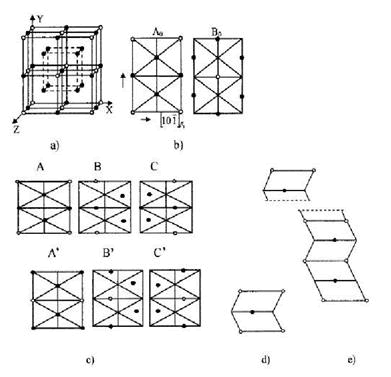
Figure 1. Structure of the austenitic and martensitic phases of the Cu-Al-Ni alloy: Unit cell (a) and plane (101) β1-phase (b); Six types of basal planes of martensitic phases (c); Alternation of base planes in structure γ1’ (d) (d) and in structure β1’ (e) [3].
In the case of superelastic deformation, the interphase boundary between the phases is coherent. Therefore, crystal lattice defects leading to disorder do not arise. For an alloy with plasticity, the interface and phase boundaries are also coherent, but a transition zone also appears, consisting of twins, which are also coherent. And in this case, there is no disorder of the crystal structure.
In both cases, crystal lattice defects leading to disorder do not arise, and entropy does not change. Figure 2 shows metallographic images of the two-phase state of samples with shape memory (plastic) and superelasticity effects. On the left side there is an austenitic phase, and on the right there is a martensitic phase [6]. The middle zone is the zone of transition from austenite to martensite. Such a multitude of phase transitions is accompanied by a change in the potential component of internal energy (U) while maintaining entropy (S).
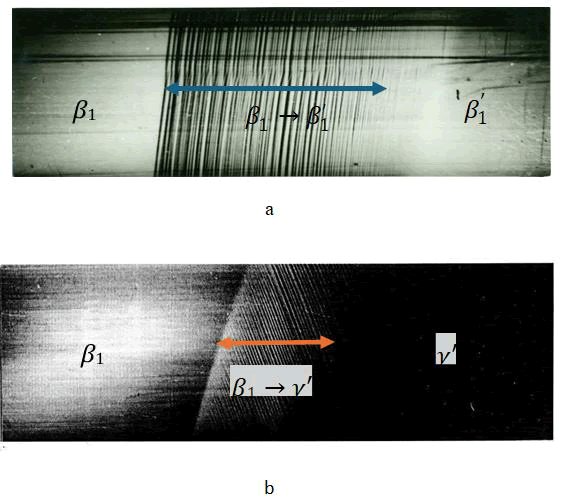
Figure 2. Metallographic images of the Cu-Al-Ni alloy in a two phase state a–alloy in a plastic state; b–alloy in a superelastic state.
Since the weight of the samples did not change during either elastic or plastic deformation, we can conclude that changes in the internal energy of the system (U) and potential σ do not affect local changes in the gravitational field strength (g) of the deformed system.
Correlation of weight with entropy
The degree of atomic disorder (S) can be changed by converting the sample from an amorphous to a crystalline state. Amorphous alloys (metallic glasses) are essentially supercooled melts and have only short-range order. Experiments have been conducted on the crystallization of amorphous metallic alloys.
The following systems have been studied: FeSi; NiSiCuTi; NiCrFeSiBMn. Metal glasses were first weighed and then annealed in a vacuum at a temperature of 8500C. X-ray diffractometry showed that after annealing the samples acquired a crystalline structure. All systems showed an increase in weight after crystallization. Annealing led to ordering of the system and, accordingly, a decrease in entropy. The results are shown in Table 1.
| Alloy composition | Initial weight in amorphous state (g) | Type of processing | Crystalline weight (g) | Weight change (g) | Weight gain in % |
| Amorphous Alloy “STEMET– 1301A” Composition: Ni–base, Cr: 7–8%, Fe: 3-4%, Si: 4-5%, B: 2-3%, Mn, O, S, C |
0,3906 | Annealing in vacuum | 0, 3958 | +0,0052 | +1,33 |
| Amorphous magnetic tape (Fe, Si: 2.14%) |
0.3448 | Annealing in vacuum | 0,3718 | +0,027 | 7,83 |
| Amorphous tape (Ni: 82.06, Si: 4.45, Cu: 1.7, Ti: 0.19) |
0,6099 | Annealing in vacuum | 0,6500 | +0,04 | 6,55 |
Table 1. Dependence of the weight of alloys on the structural state.
The maximum weight increase (7.83%) was noted during crystallization of the FeSi alloy, the minimum (1.33%) for the NiCrFeSiBMn alloy. Experiments with the Cu-Al-Ni alloy showed that changes in U and σ do not affect the weight. Consequently, the weight increase during crystallization of amorphous alloys is associated with a decrease in their entropy S.
Experiments were conducted on eutectoid steel. The weight of the steel after quenching in water and subsequent annealing in vacuum at 8500C was compared. The quenching structure is a mechanical mixture of ferrite, martensite and residual austenite. In this case, quenching defects arise, creating local disordering of the crystal lattice. After annealing the quenched steel, the structure transformed into pearlite-a thermodynamically equilibrium two-phase state. The disorder decreased, and the weight of the sample increased. The results are given in Table 2.
When weighing, an increase in the weight of the annealed sample after quenching by 0.17% was recorded. Annealing in a vacuum eliminated oxidation and possible weight changes.
Consequently, it is associated only with the thermodynamic state of the sample.
| Type of processing | Weight (g) | Type of | Weight (g) | Change Weight (g) | Weight gain % |
| Hardening in liquid nitrogen from 8500C | 232,933 | Annealing in vacuum 8500C | 232,967 | +0,0041 | 0.017 |
| Hardening in water from 8500C and liquid nitrogen | 230,821 | Annealing in vacuum 8500C | 230,836 | +0,0039 | 0.017 |
Table 2. Dependence of steel weight on the type of heat treatment.
The effect of ordering on weight can be observed in liquid systems dynamically (in situ). Experiments were performed on the electrolysis of an aqueous solution of liquid soap. Liquid soap is a surfactant. It consists of one-dimensional elongated amphiphilic molecules, the head of which has a polar part. In a constant electric field, these molecules acquire a directional orientation. The chaotic distribution of molecules in the absence of an electric field is replaced by an ordered one [7,8]. This leads to a decrease in the entropy of the system.
The experimental procedure is presented in Figure 3 (a). A bowl (2) with an aqueous solution of liquid soap (3) was placed on the scale platform (1). Electrodes (4) were lowered into the solution from above, rigidly mounted on a tripod (5) and not in contact with the scales.
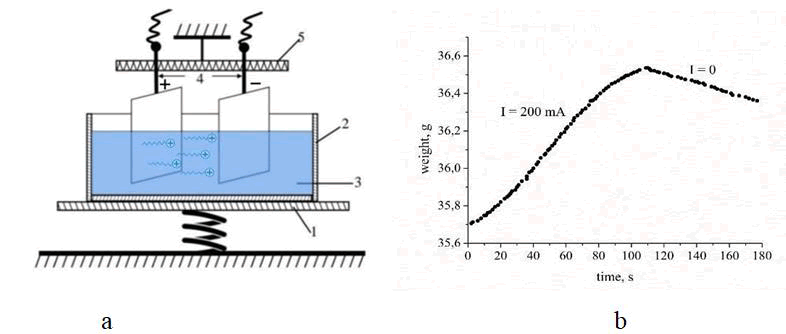
Figure 3. Scheme of weighing a liquid system during the electrolysis process: 1-scales, 2-container, 3-liquid phase, 4-electrodes, 5-stand–insulator (a); dependence of the weight of liquid soap on electrolysis time (b).
During electrolysis, the amphiphilic molecules of liquid soap are oriented in the direction of the electric field not immediately, but gradually. The entropy of the system decreases and the weight of the liquid soap increases. When the electric field is turned off, the directional orientation of the molecules is destroyed due to diffusion processes, and the entropy and weight of the solution decrease (Figure 3b).
During electrolysis for 110 seconds, the weight of liquid soap increased by 1.9%.
A similar experiment with H2O and aqueous solutions of CuSO4 and NaCl salts did not show any changes in weight. In these liquids, there is no ordering during electrolysis.
To eliminate the influence of the electric field on the operation of the electronic scales, an electrical resistance having almost the same weight as liquid systems was weighed. When a current 5 times greater was passed through it compared to the currents during electrolysis, there was no change in weight in Figure 4.
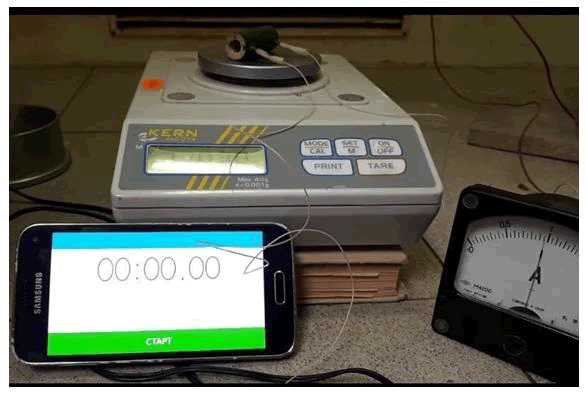
Figure 4. Photo of an experiment with a resistor through which electricity is passed.
And finally, it is well known that the entropy of any substance increases in the sequence: Solid→ liquid→ gas.
Measurements were made with epoxy resin curing from a liquid state. After 24 hours of polymerization, the weight increased by 0.08% (Table 3).
| Material | Starting weight (g) | Curing time/weight (g) | Weight gain per day% | |||
| Epoxy resin | 164,403 | 10 min/16,4427 | 15 min/16,4439 | 3 h./16,4511 | 24 h./16,4542 | 0,08% |
Table 3. Dependence of the weight of epoxy resin on hardening time.
The work experimentally proved the influence of entropy on the weight of condensed material substance. Experiments with Cu-Al-Ni alloy showed quite convincingly that in the absence of disordering of the crystal lattice, the weight of the samples did not change either during elastic or plastic deformation. Phase transformations during deformation changed the internal energy, but the entropy in this alloy did not change. Internal stresses also did not affect the weight.
Experiments with other solid and liquid materials have confirmed that weight changes correlate with changes in their structural disorder, i.e., with entropy.
In nonrelativistic mechanics, the weight of a constant amount of matter can change only due to changes in the gravitational field strength. Consequently, a change in the entropy of a material body leads to a local change in the gravitational field strength.
Mass can be considered as a space-time defect. Mass deforms space-time. Experiments have shown that the greater the orderliness of the mass structure, the greater the gravitational field strength, and the greater the curvature (deformation) of space-time. Disordering of the structure (entropy increase) reduces the curvature of space-time, i.e., reduces its defectiveness.
Consequently, entropy is not wasted energy, but energy spent on locally reducing the deformation of space-time, i.e., on work to reduce the intensity of the gravitational field.
[Crossref] [Google Scholar] [PubMed]